This video shows the player finding a clue and how it is added to the board.
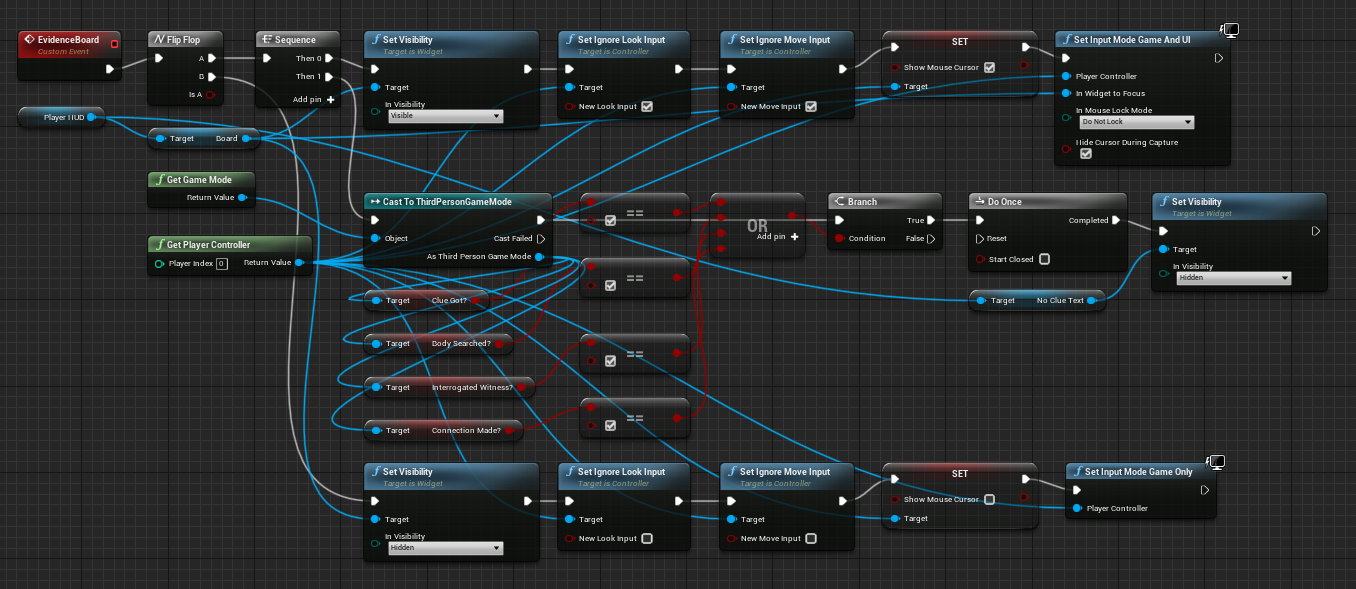
This image shows the event in the blueprint that manages the visibility of the evidence board UI and whether the no clues message should be displayed.
This video shows the player crouching to explore a vent resulting in the player finding a new clue.
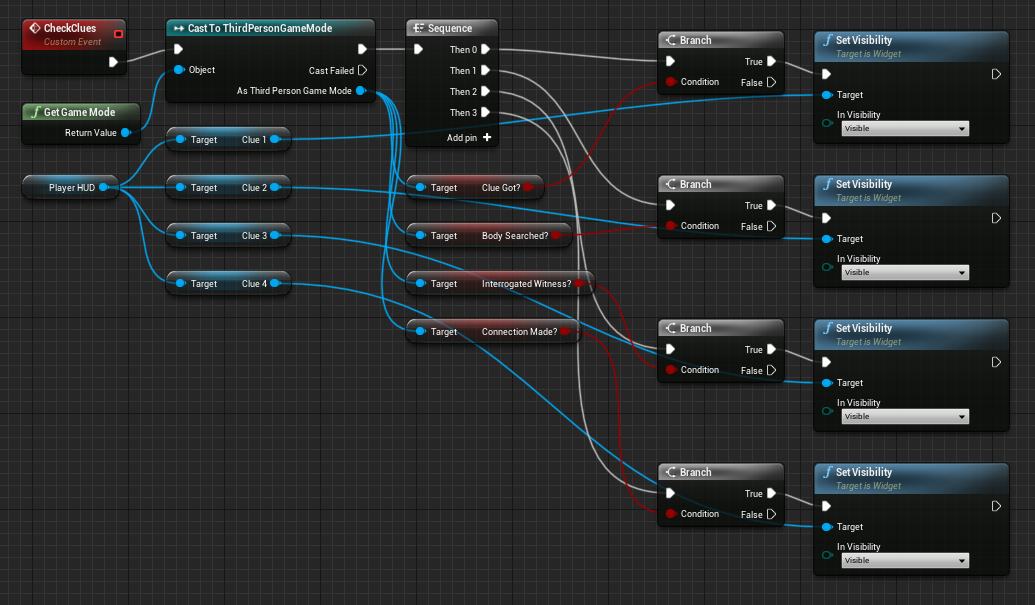
This image shows the event in the blueprint that is responsible for checking what clues the player has found in the prototype.
This video shows an early version of the dialogue system with multiple dialogue options.
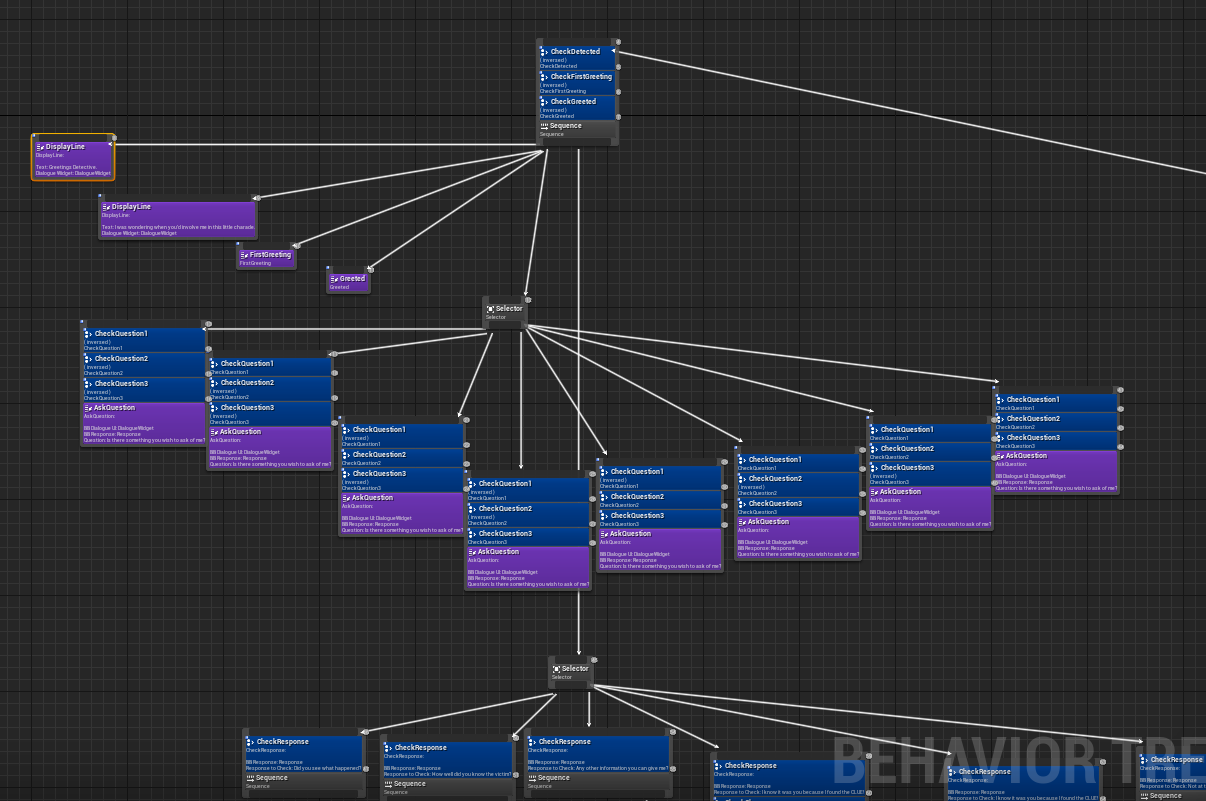
This is an example of how the dialogue tree is structured within Unreal. Although this is only a part of the dialogue tree above it shows some of the conditions and checks that are involved in the dialogue.
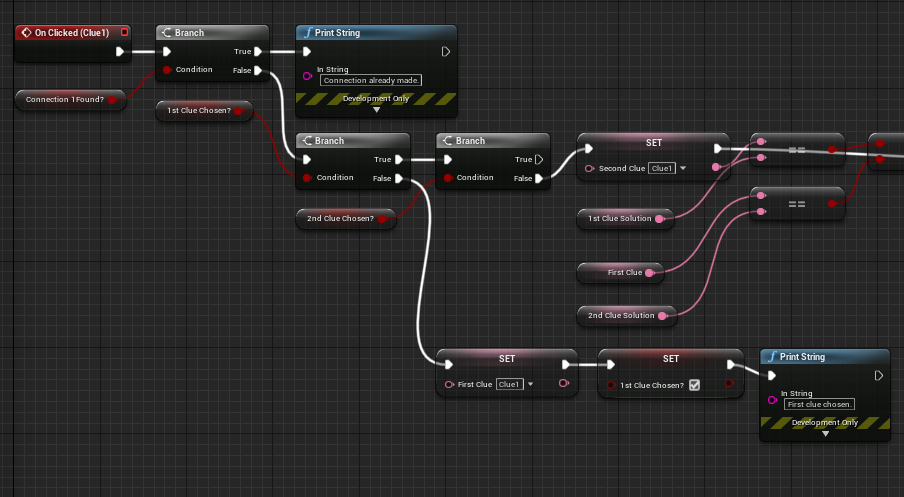
This video shows the player making deductions by connecting the pieces of evidence together. This unlocks new clues and dialogue options. It is a simple iteration of the system for the moment as it was just to show the basics of how the mechanic will function. This system will be further developed to be more complex as the project continues. These images show part of the deduction blueprinting. This part controls the selection of the first clue and determines whether it is clicked first or second and if it connected to the right clue.This video displays the changes that occur in the dialogue when the player has spoken to the NPC more than once and when the player has the clue.
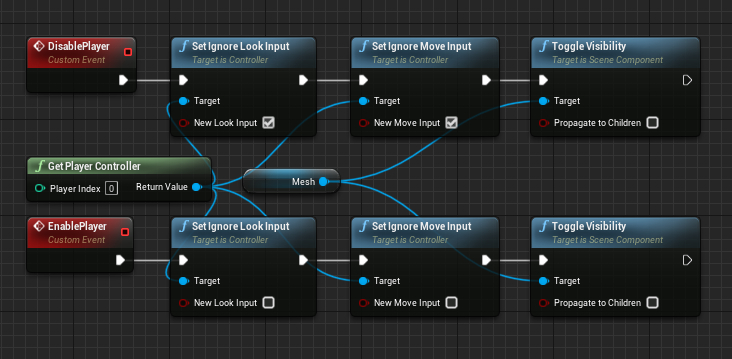
This image shows the events responsible for enabling and disabling the player in the blueprint when the player talks to NPCs as the player could be in a position that would block the dialogue camera.
Prototype Playthrough:
This video shows a full playthrough of this prototype.
Feedback Changes:
Our early control scheme had the E key serve as the interaction button for the actions the player could do and the left mouse button was used to click on dialogue options. A bit of feedback we received was that these two controls could be combined. There was no important reason why this couldn’t be the case so in our project currently the left mouse button is used for both.
One bit of feedback received from testers was that there was no indication to the player on the evidence board that the player hasn’t collected any clues. To rectify this a message now appears before the player has found any clues. In the final project, this may be indicated in a different way but for now this does the job.
Originally the idea was to have the game mainly in first person with a third person perspective when the player was travelling between crime scenes. However, when the game scope was lowered to being just on the boat it was causing a lot more visibility issues than it was worth. Feedback was also received on this feature saying that it was unnecessary and added just for the sake of it. This feature is shown below but it has been cut from the game.
Our original idea was to have the game start on the boat and for this murder mystery to be the tutorial for a game with multiple crimes to solve. However, pretty early we decided to downsize our idea so that it the game at least majorly took place on the boat. This allowed us to keep our scope pretty feasible to make in the time we have available.
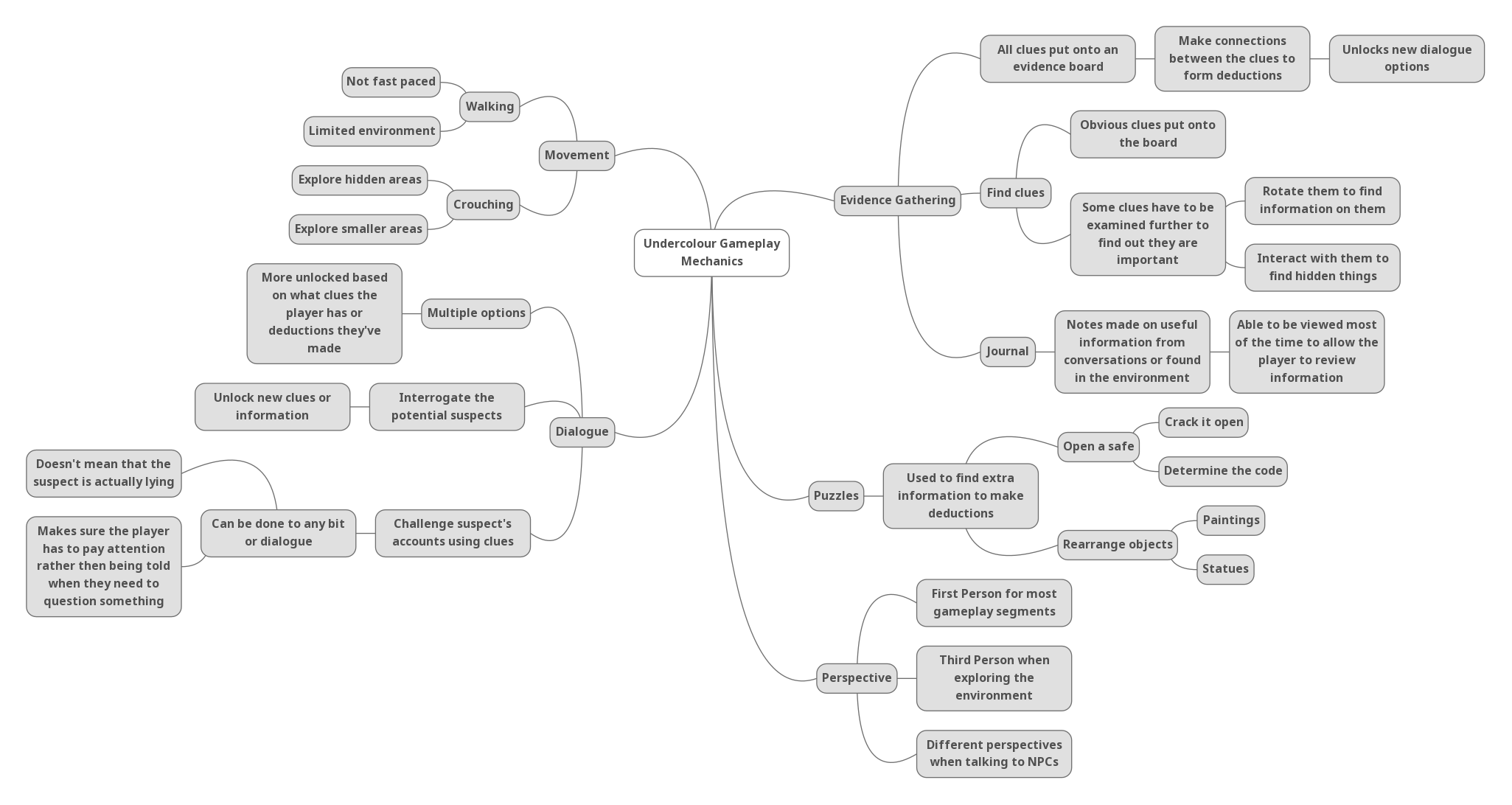
I made a mind map of the gameplay mechanics we had ideas for at this stage. As these are implemented into the prototype or main project I will be able to determine how feasible these are to make. This allows me to make any adjustments to their intended implementation or replace them with a mechanic that can fulfil the same role. I can also determine any mechanics that aren’t necessary for our project.
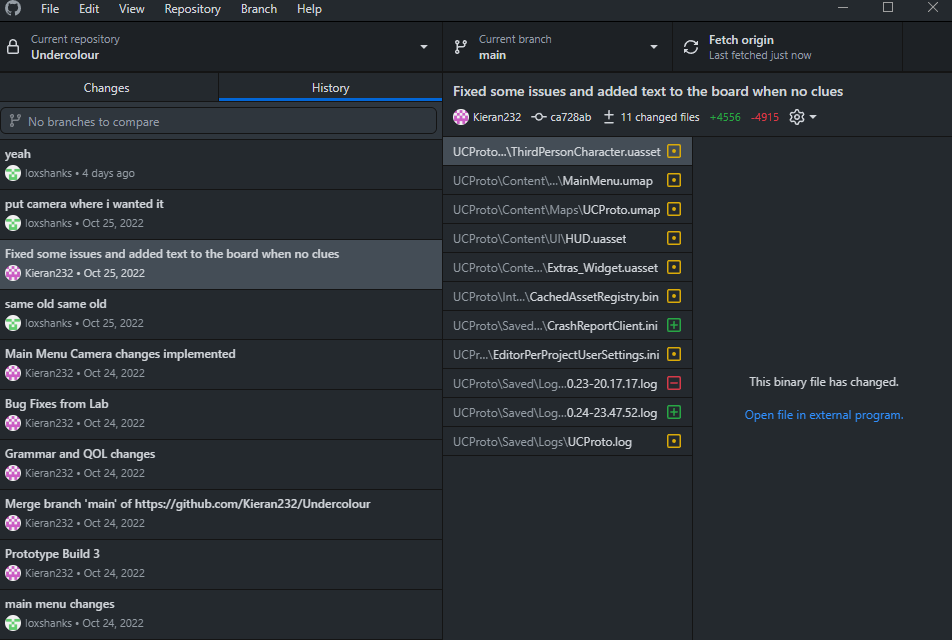
To allow us to work on the prototype and later the full project as a team, I set up a GitHub Unreal Engine project. This allows us to work on separate computers while still contributing work to the same Unreal project. This saves time later in development as otherwise one of our team member’s would have to compile all the different parts of our project into one project which could prove quite tedious and mistakes could be made that only the respective team member’s could fix easily.
In the early stages of our project, while we were still figuring out our ideas we did some research into different media that would assist us in developing our ideas. Below I have separated the inspirations into some that are more generally for the project and my personal inspirations for the project.
Project Inspiration:
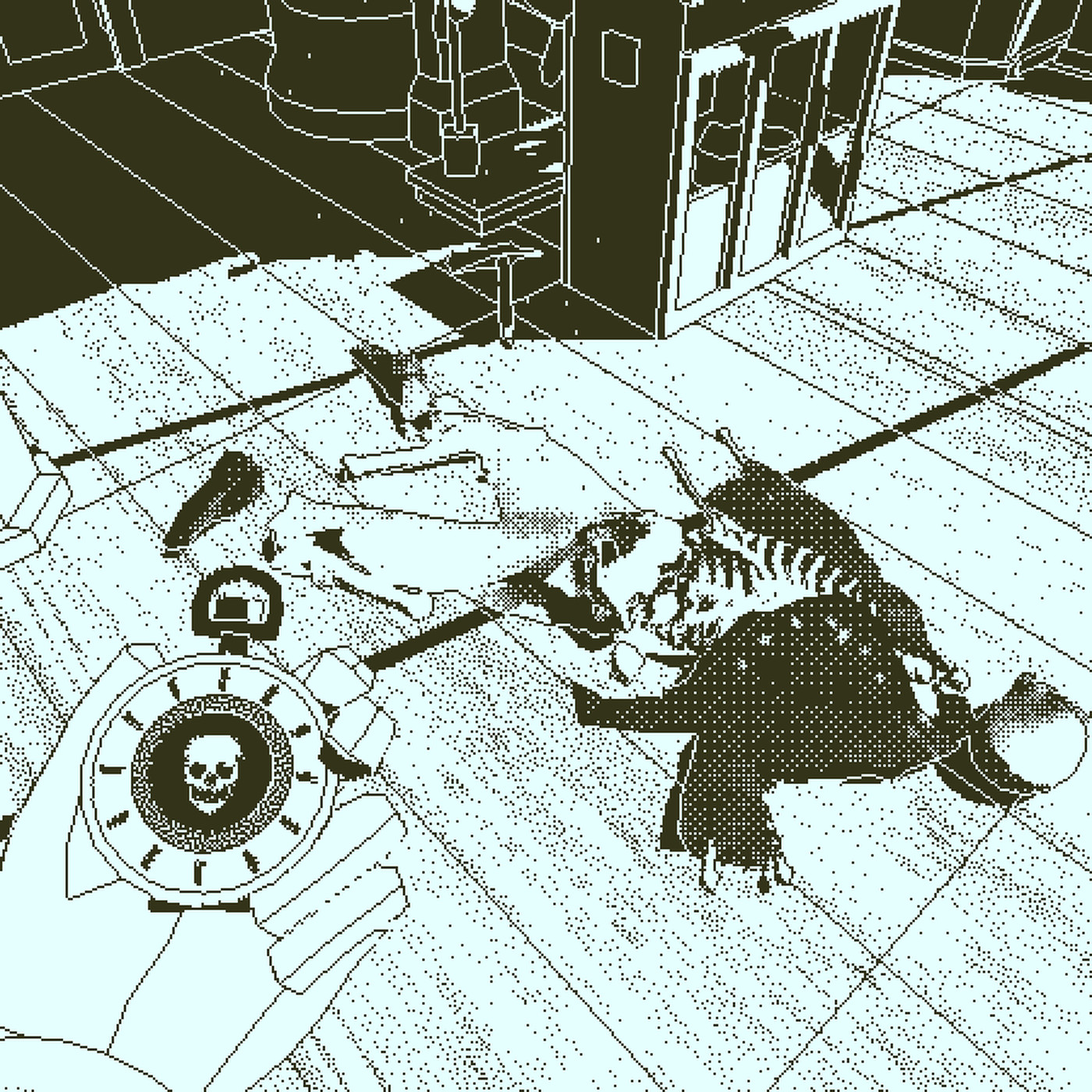
The Return of the Obra Dinn (Game): This game is quite influential in the direction of our game as it truly allows the player to actually figure out mysteries on their own. The specific use of the journal and its assistance in figuring out each of the deaths on the Obra Dinn is something that we will adapt for our game as we will implement a journal that contains notes on information the player finds throughout the game. We will also take inspiration on is how you can only guess when you have enough information and how the game never explicitly tells you whether a deduction is correct as we want to implement something similar within our game but not necessarily to the same extent.
The Return of the Obra Dinn Screenshot (Webster, 2018)
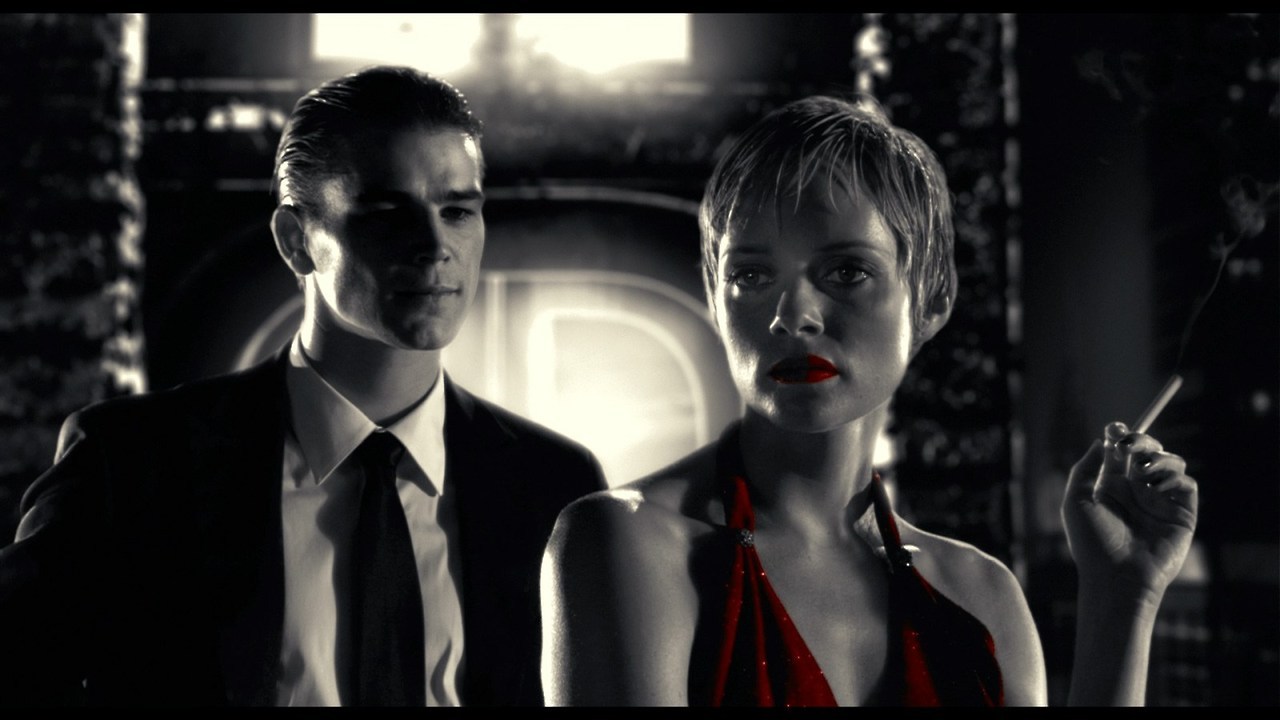
Sin City (Film): The visual style used in the movie Sin City is quite similar to the idea we had for our visual style as it also is mainly black and white while highlighting specific colours such as red. This is why we are using this as inspiration for how we can implement the visual style. The usage of highlighting specific colours could be used to draw the player’s attention to important objects and areas in the environment like how in the movie they use the mostly black and white colour scheme to provide emphasis to specific things.
Sin City Image (inspiraze, 2017)
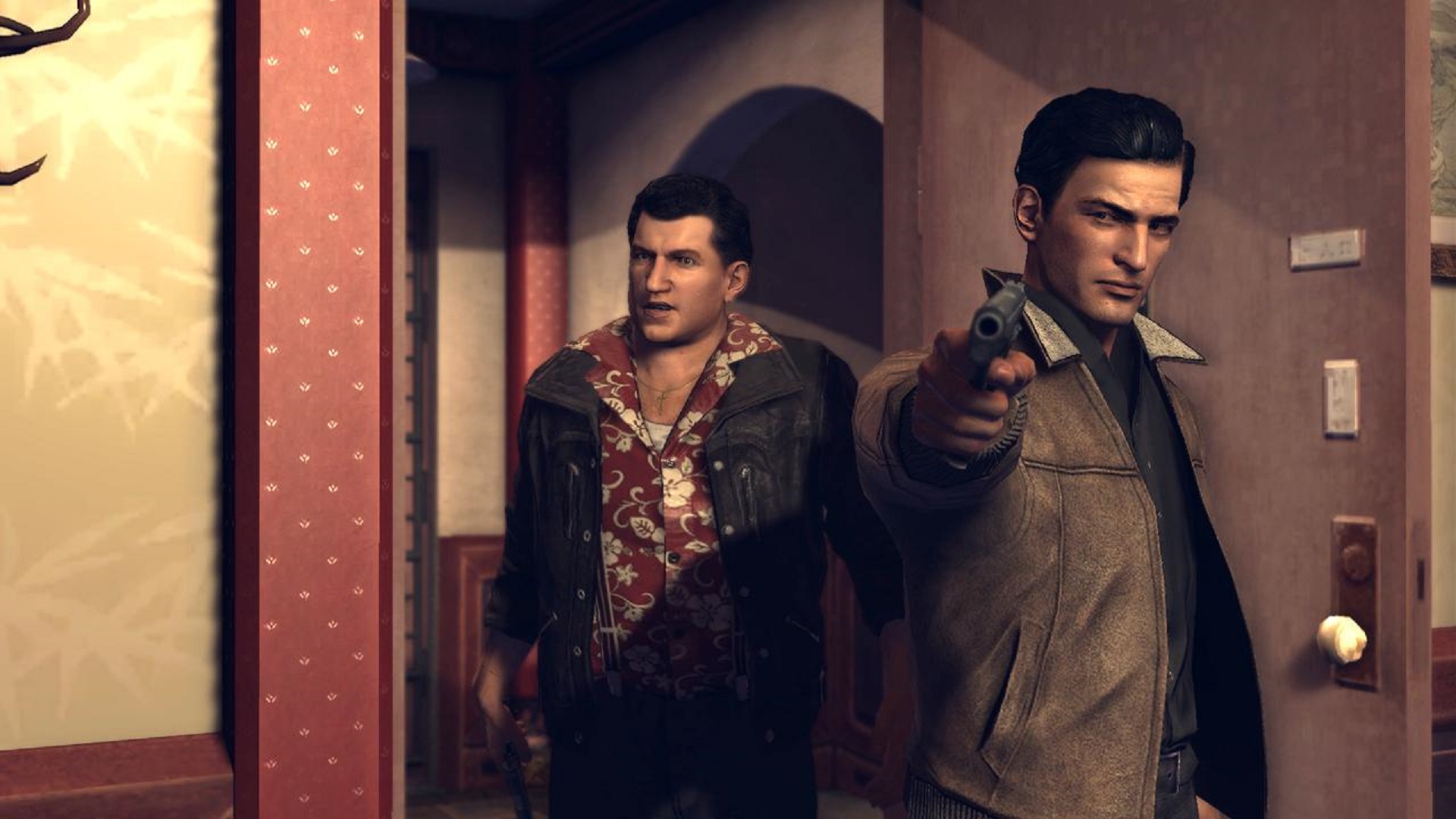
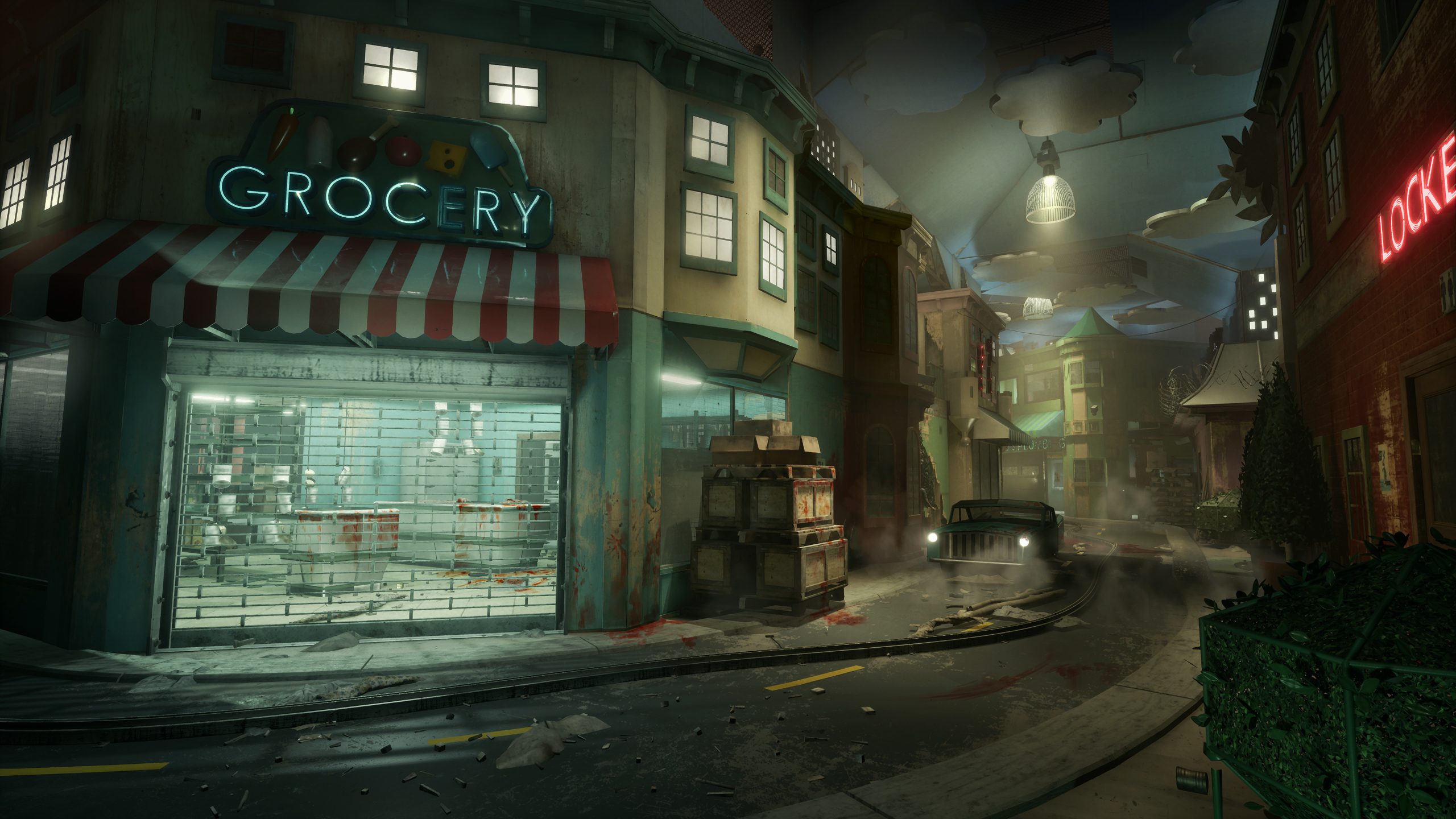
Mafia 2 (Game): Mafia 2 is set in a similar time period to our game idea so the aesthetics of both characters and the environments are good inspiration for how our game could look. It can also serve as inspiration for how some of the character’s could act to match the time period.
Mafia 2 Screenshot (Wald, 2020)
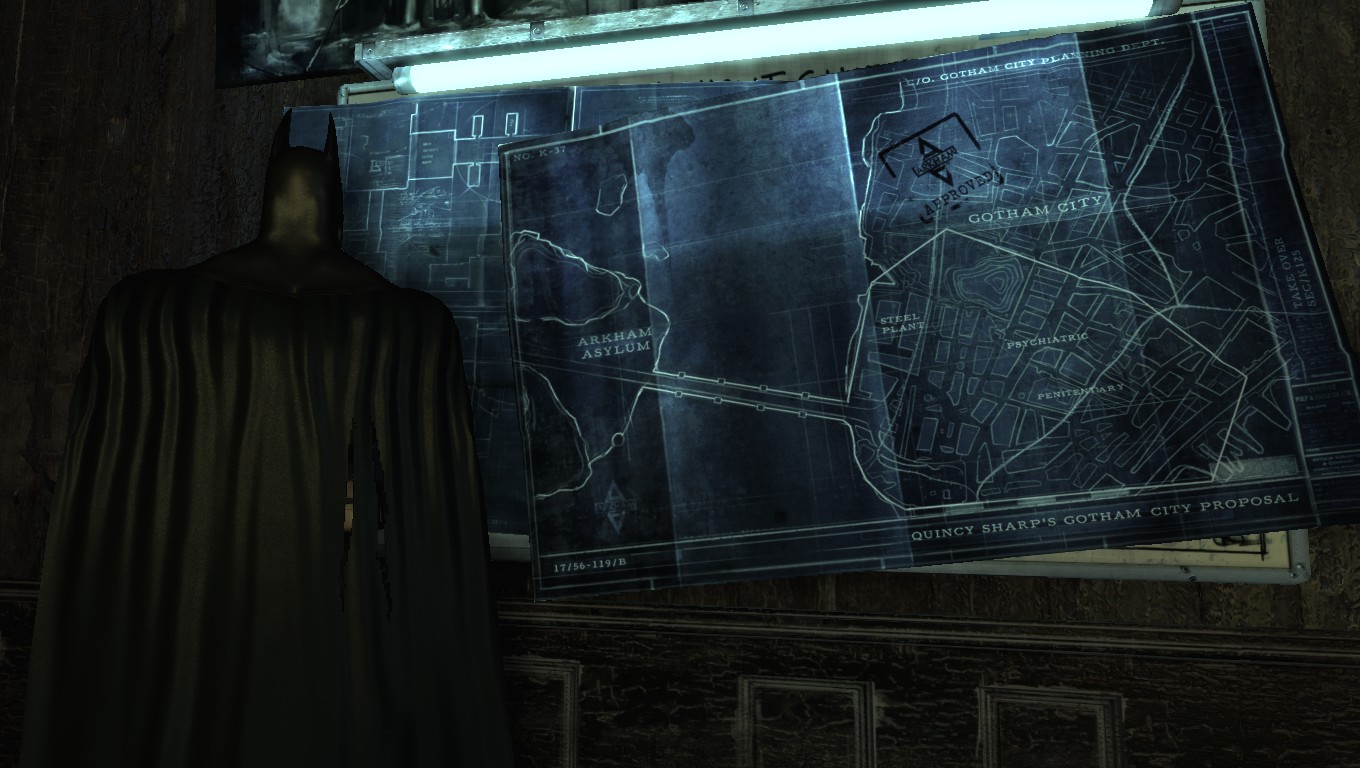
Batman Arkham Asylum (Game): Batman Arkham Asylum as a game has multiple things we can draw inspiration from. Although the actual detective parts of the game are quite limited due to that not being a primary focus of the game, the way in which the player examines the environment in certain parts of the game can serve as inspiration for when we look for clues in our project. However, our implementation would be a lot less technological and would make it a lot less obvious. The way in which certain collectables are placed is another bit of inspiration for our gameplay as we aim to hide clues in hidden places. The UI within the game also served as inspiration for how some of our UI could potentially be implemented as it has a very stylised look.
Batman Arkham Asylum Screenshot (Saint Aaron, 2015)
Personal Inspiration:
How to make a good detective game – Game Maker’s Toolkit (YouTube Video): This video is very insightful on how to implement detective mechanics into our project without making it explicitly obvious what the right thing to do is. Using this as inspiration for how we structure our game will allow us to make the player feel like they are actually a detective rather than just being able to guess the correct sequence of events. This video is especially important as a lot of the game inspirations we have handhold the player in some ways with their deductions so keeping this in mind will help us to not help the player along too much.
What Makes a Good Detective Game? (Game Maker’s Toolkit, 2017)
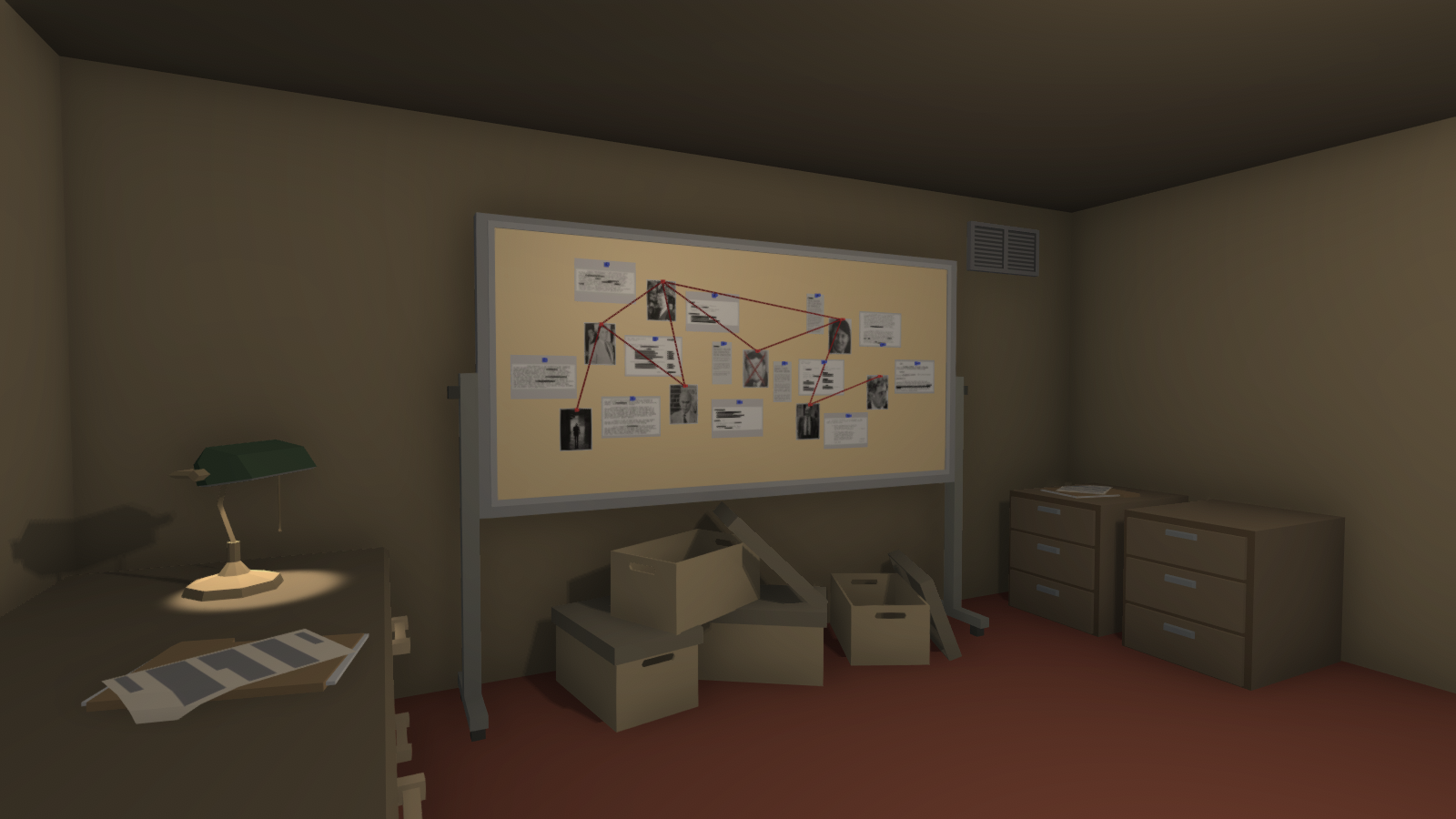
A Hand with Many Fingers (Game): This game is about the player putting together a conspiracy with the files they can find within an archive. It serves as good inspiration as it utilises an evidence board as a primary mechanic which is something we wish to include in our game. However, the way the player searches through files to uncover clues that may connect to the clues they already have so they are able to make deductions is another thing we can take inspiration from while developing our game.
A Hand With Many Fingers Screenshot (Colestia, 2020)
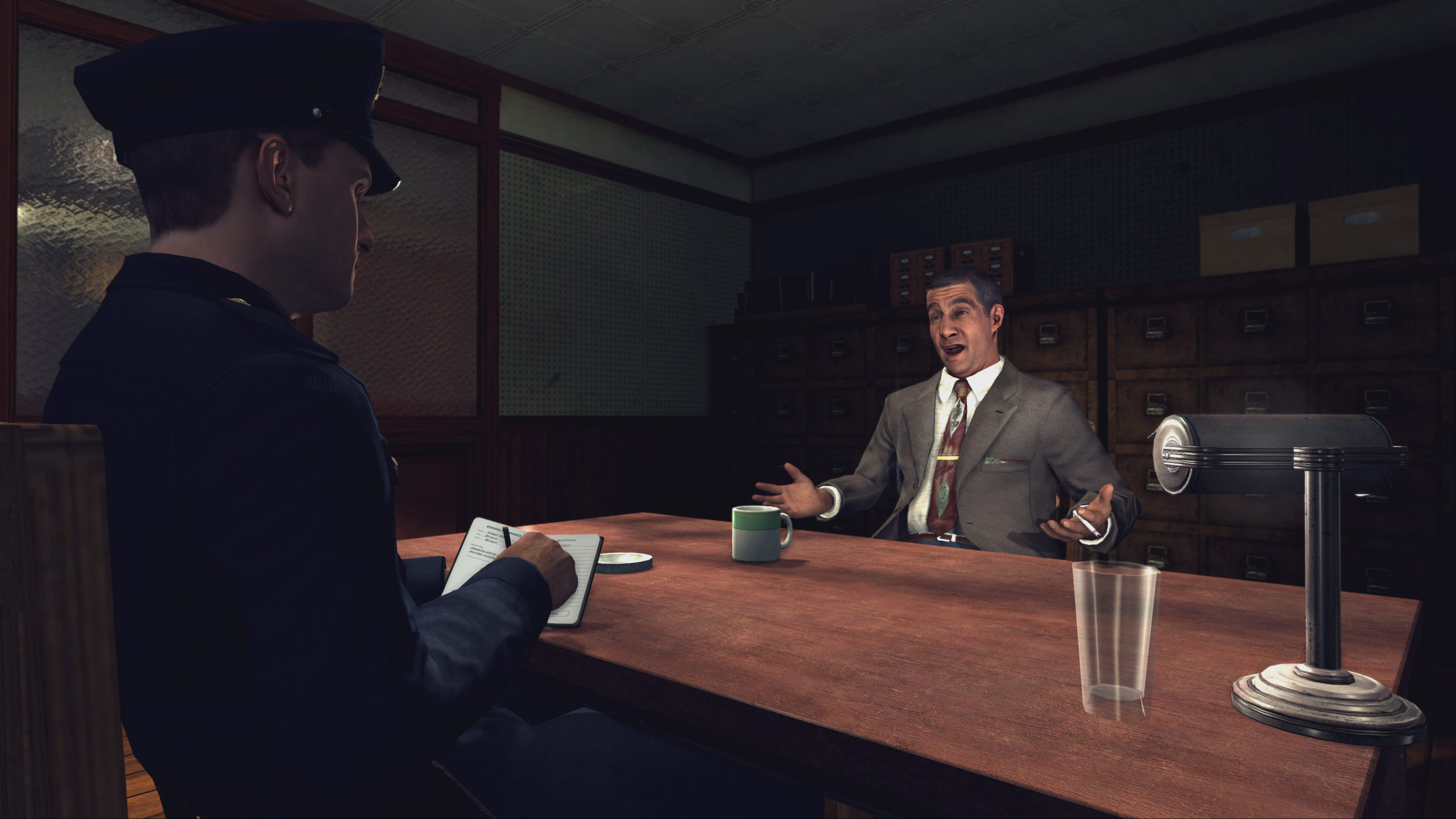
L.A. Noire (Game): As this game is also a detective game it can serve as good inspiration for how to implement some of our mechanics. The acquisition of clues within the various environments is a good thing to take inspiration from as the player can pick up and examine a variety of objects with some being completely irrelevant. This is good for our game as only being able to interact with the important objects would make it so the player can find the clues pretty easily. The way the player examines the objects is by rotating them or interacting with them in some way to get a clue from them which if implemented into our game would add more player input in the gathering of clues. The dialogue system in L.A. Noire allows the player to question suspects using the relevant clues they have gathered and then choose whether: they think the suspect was telling the truth, they doubt the suspect or if the suspect was telling a lie. The usage of relevant clues is good inspiration for our game but the second part of the dialogue system makes it that most of the time you know you have to question the suspect’s testimony. In our project, we would like to make it less obvious whether the suspects are misleading the player.
Our project is a murder mystery game on a boat at the turn of the 20th century. It will be developed on Unreal Engine 4. The aim of the player is to solve the murder before the boat is able to dock. From a first-person perspective, the player will explore the boat to find evidence and interrogate suspects to determine which passenger may be the killer.
My role:
My main role within our project is programmer/blueprinter which means I am responsible for getting the main systems and mechanics within the game to function. I will start by determining what mechanics we are going to need and then getting these mechanics to work in a test prototype. I can figure out any issues that need to be fixed as well as adjust how they work if feedback from testers deems it necessary to do so. I will be the one implementing most of the gameplay scenarios that are designed by our team. As the story progression comes together, I will be able to use the mechanics I already created to put the game together as we further develop it.
Genre:
Our game’s genre is noir detective thriller. This matches our project as we want to create suspense as the player tries to deduce who the killer is. Each character will be morally ambiguous and have their own motives for potentially being the murderer.
Setting:
The game will take place on a paddle-steamer travelling the swamps of New Orleans known as the SS Arctic. This limited environment allows us to make our game feel a lot more close-quarters to make the urgency of finding the killer higher. It also make the scope of our project more manageable as focusing on one environment will allow us to improve the quality of our end project.
Story:
Detective CC Tinsley by complete coincidence finds himself embroiled in a murder mystery while on a journey across the Mississippi onboard the SS Arctic as the host of a gathering of old “friends” dies under mysterious circumstances. He must determine the exact events behind this tragic occurrence before the boat reaches its destination as he is the only passenger with no links to any of the other passengers including the murder victim.
Characters:
The characters we aim to include in our game are listed below. We wish to have a range of personalities and backstories which will be fully determined as we start fully developing our project. This will also allow the rooms of each character to be visually distinct and have unique items related to them.
CC Tinsley (Player Character)
Captain Luce (American)
William Eubanks (American)
Fernand Lacroix (French)
David Kirkwood (British)
Irene McAllister (British)
Lillian Brown (American)
Mr Watanabe (Japanese)
Franz Haber (Prussian)
Gameplay Mechanics:
As part of our proposal we outlined some basic mechanics that we could have in our game. Part of my role will be determining the extent of these mechanics and how they will be implemented.
The game will be at least mainly in first person with the character having the ability to walk and crouch.
Crouching will allow the player to find evidence in more hidden areas.
There will be a conversation system in which the player can question the NPCs with various dialogue options which will also allow the player to challenge their account of events.
Clues the player finds may not be immediately useful and may require further inspection to find their relevance for example rotating them to find some more information.
The evidence the player finds will be displayed on an evidence board which allows the player to make deductions by connecting these clues together.
The player will have a journal which makes notes on information the player receives whether its directly relevant or not.
Puzzles could also be included in our game to find information such as safe cracking or rearranging paintings but this is not a high priority inclusion. It may also clash with our game style if it not implemented in a way that is believable in our game world.
Visual Style:
While in the concept phase for our project, we had a very strong idea for what our visual style would be. This was a black and white style but specific colours such as red would be in full colour. While not a completely original idea, we thought this would be a great contrast as well as really complementing our project’s genre. This could be applied by using a filter within Unreal Engine to make most things appear black and white. While further developing this idea, we brought up the idea of it not being fully black and white but the filter being tuned down a little so there is some semblance of colour but the colours would be very moody to still match our game’s atmosphere well. We will fully determine the visual style after experimentation within our Unreal project.
Audio Considerations:
Although none of our team members strengths involve audio we still wanted to take some audio considerations into mind as audio can be really important in creating the feel of the game. Some examples of audio we determined as being important to our project are:
⦁ Ocean sounds/rain
⦁ Boat sounds, engine, creaking etc.
The inclusion of these help to immerse the character in the setting as a lack of these sounds would make it less believable.
⦁ Atmospheric background music
Including background music would help to set the various moods and feelings we want to create throughout our project.
⦁ Crowd muttering
⦁ Character voices/mumbling
These would help to make the environment feel more alive as the environment wouldn’t be completely silent with passengers and staff on the boat especially after a murder. Giving the character’s voices would also improve the player being able to discern the feelings of the characters.
⦁ Jazz or appropriate music.
This music will be mainly used on the main menu so it has to introduce the player to our theme and it matches the time setting of our game well.
⦁ Footsteps
Adding footsteps for the character will better immerse the player in the game. They will change depending on the material the player is walking on to increase the immersion.
The willing hero of the story. Ventures to the rural town of Red Oak in search of a missing biology student. At first, he struggles with the events happening in the town but adapts to the situation as he is determined to save the student. The character arc is that he leaves the town with a new conviction of taking down the Dymon Corporation as their sinister deeds can’t go unpunished.
Rian Sanderson
Serves as the herald for our primary protagonist as his disappearance is the catalyst for the start of the story and is what draws the main character to the Red Oak Quarantine Zone. A prodigy biology student at Red Oak University specifically targeted by the Dymon Corporation for his unique skillset. His arc is that he goes from being an innocent student working alongside the Dymon Corporation to directly opposing them after the horrific events he was involved in at Red Oak.
Doctor Harold Richmond
The primary antagonist as his research is what causes the outbreak in the first place. His incessant need for results to gain profit for the company allows the initial accident to happen. Also takes a shapeshifter role as he at first seems kind and committed to good causes to Rian Sanderson until he reveals his true nature in a failed attempt to get Rian to help his research. Doesn’t have much of a presence in the game but his actions are what causes most of the problems encountered in the story.
Operative D-14
A secondary antagonist for the majority of the game as well as an alternate protagonist to show the events from another perspective. They start antagonistic to the main character as their job is to remove any threats to the Dymon Corporation which includes witnesses to the Red Oak events but this changes as they start to question their actions due to the emotional toll. Their arc is that they become an ally to our main hero at the end of the story and allow them to escape.
Zombies
The infected creatures serve as threshold guardians within the game as they are used to stop the player from progressing. The plan is to have multiple variations that serve as bigger threats.
It was a well known fact that the town of Red Oak has long been associated with the Dymon Corporation but the extent of their involvement in the town as it turns out is far more sinister. The town serves as a cover for a secret laboratory that engages in unethical human experimentation to try and push human ability far beyond natural levels. A viral agent previously used in these experiments is accidentally released causing an outbreak in the town. This specific viral agent was deemed too dangerous as it had the horrific side effects of taking over a person’s mind and mutation with prolonged use. Unfortunately for you, a student has been reported missing in the rural town of Red Oak and you are the private investigator tasked with finding him. What you thought would be a simple job ends up being much more than you bargained for as you find yourself struggling against these creatures that before today would only exist in your nightmares.
Characters
Nathan Cross – A private investigator hired to find missing student Rian Sanderson within the rural town of Red Oak. He is determined to find Rian even if it means risking his own life. He will serve as the player character for most of the game experience.
Rian Sanderson – A biology student prodigy at Red Oak University. Has a scholarship sponsored by the Dymon Corporation. He is very passionate about vaccine research. The Dymon Corporation seeks to use his skills in their illicit research which he is initially unaware off.
Operative D-14 – A mysterious agent working for the Dymon Corporation. Employed to protect the image of the company at all costs. At first, they are unwavering in their loyalty to the corporation but the terrible acts they are ordered to commit in Red Oak starts to take a toll. Secondary player character for some segments of the game experience.
Doctor Harold Richmond – The head of research at the Dymon Corporation Red Oak Lab. A cynical man only focused on getting results on his illicit research. This focus on results is what allows the inciting incident to occur in the first place.
Structure
My story is structured in the usual three acts as it works perfectly for the way I am presenting my story in my short game experience. However, there will still be complexity in my structure as I will be utilising the In Media Res storytelling technique in the first act to hook the player’s into my story. I also intend to use the Monomyth or Hero’s Journey as Nathan Cross will leave Red Oak with a new conviction of exposing the sinister nature of the Dymon Corporation. The narrative is multi-layered as there will be multiple perspectives on the events happening in Red Oak allowing the player to see different outlooks on the situation from opposing sides.
First Act: The player is at first in control of Operative D-14 as they clearing a section of the underground lab in search of potential witnesses. The player clears the area of all infected creatures and then finds Nathan Cross and Rian Sanderson. Nathan Cross pleads for D-14 to let them leave and then the screen fades to black. The player now is in control of Nathan Cross earlier that day as he has entered the Red Oak Quarantine Zone. The player explores an abandoned checkpoint and has a first encounter with a zombie. At this point, the player has no weapon so the player has to run. The player finds a handgun on a corpse and dispatches the first zombie.
Second Act: This part of the game is more open as the player is free to explore a small group of houses. It is in this section that the player can find various notes and documents detailing events that occurred in the quarantined area. The aim is to find information on the whereabouts of Rian Sanderson. One of the houses belongs to a Doctor Richmond which contains a hidden entrance to the underground lab. The player has to find a keycard in this open area before being able to progress into the lab. Optional playable section in which the player finds footage of D-14 and their squad killing witnesses.
Third Act: The third act consists of searching the lab. This act is more linear but there are still notes and documents containing information on important elements of the story. The player can piece together exactly how the virus spread as they explore this lab. As the player reaches the end of the playable part of the lab, they discover Rian Sanderson hidden away in a locked room. Opening the room starts an alarm that summons a horde of zombies and the story catches up to the situation set up at the start. Operative D-14 lets Nathan Cross and Rian Sanderson leave as they can no longer cope with the guilt of what they have done in service of the Dymon Corporation.
Themes
The theme that I aim for my story to have is “the devastating effects of corporate greed”. The nefarious experiments that Doctor Richmond and Dymon Corp committed were to gain results in their aim to push human ability further than naturally possible. This was all to increase the income of the company by selling the viral agents to various militaristic organisations all over the world.
Setting
The period in which the story is set in is a version of our modern day. This means that everything in the game should make sense to real life. The zombie and viral agent elements of the game don’t work in a real world scenario but they will be explained in a way that would somewhat make sense in real life. The story takes place in one night as the player explores the Red Oak Quarantine Zone. The story takes place in a rural english town known as Red Oak with a secret underground lab. The main conflict in the game is the main character Nathan Cross surviving against the creatures and forces of the Dymon Corporation. However, there are secondary conflicts of Rian Sanderson discovering the nefarious plans of Doctor Richmond and Operative D-14 struggling to cope with the horrific actions they are ordered to do.
Tone
The story is being told through the eyes of a private investigator and a corporate operative allowing different perspectives on a mostly linear story. The tone will be quite serious as I aim to tell quite a serious story and without a tone that matches it may not work that well.
Initially, I started thinking of the software I would like to use for my digital story. As I would primarily like to pursue game programming professionally, I would prefer to use a game engine in which I can showcase my programming ability. I would prefer to use a version of Unreal Engine as I have most recently been using the Unreal blueprinting system to program my games. However, I also have some experience in creating modifications for Bethesda games such as Fallout 3 and Fallout New Vegas in their respective creation kits which serve as a more restrictive version of a game engine.
Ideas Generation
Idea 1:
A small first person game experience set in a quarantined housing block infested with creatures reanimated by a manmade pathogen which the player character travels to in search of a missing student. The focus will be on environmental storytelling as I would prefer for the player to piece together an idea of what happened themselves but certain information will be given to the player to help this process. The player will at first be confused by the events inside the quarantined area so part of the story will include the player character struggling to survive. The game won’t be too gameplay intensive as the priority is on the story although I do intend to include combat with some enemies.
What If: What if a student went missing in a small neighborhood infested with zombies?
Controlling Idea: How does experiencing a horrific event change a person?
Idea 2:
A game modification for Fallout 3 or Fallout New Vegas that would aim to expand on a story or plot thread from the main game. The aim of the modification would be to add some further complexity to the lore of the game while the story is an original creation that would fit within the respective game’s universe. One idea I had of a potential story I could do in either of the games is expand upon an existing or create a new vault experiment with links to some of the characters from the main game. The player would have to make difficult choices to survive the vault experiment potentially having disastrous consequences for other people.
What If: What if the player is caught in a vault experiment?
Controlling Idea: What will a person do to survive at any cost?
Chosen Idea:
I decided on my first idea for this project as I was more passionate about it and it will help me to showcase the skills I have most recently developed. The idea was originally a much bigger game experience but in order to make it in the time I have I have adapted it to a much smaller scale.
Inspiration
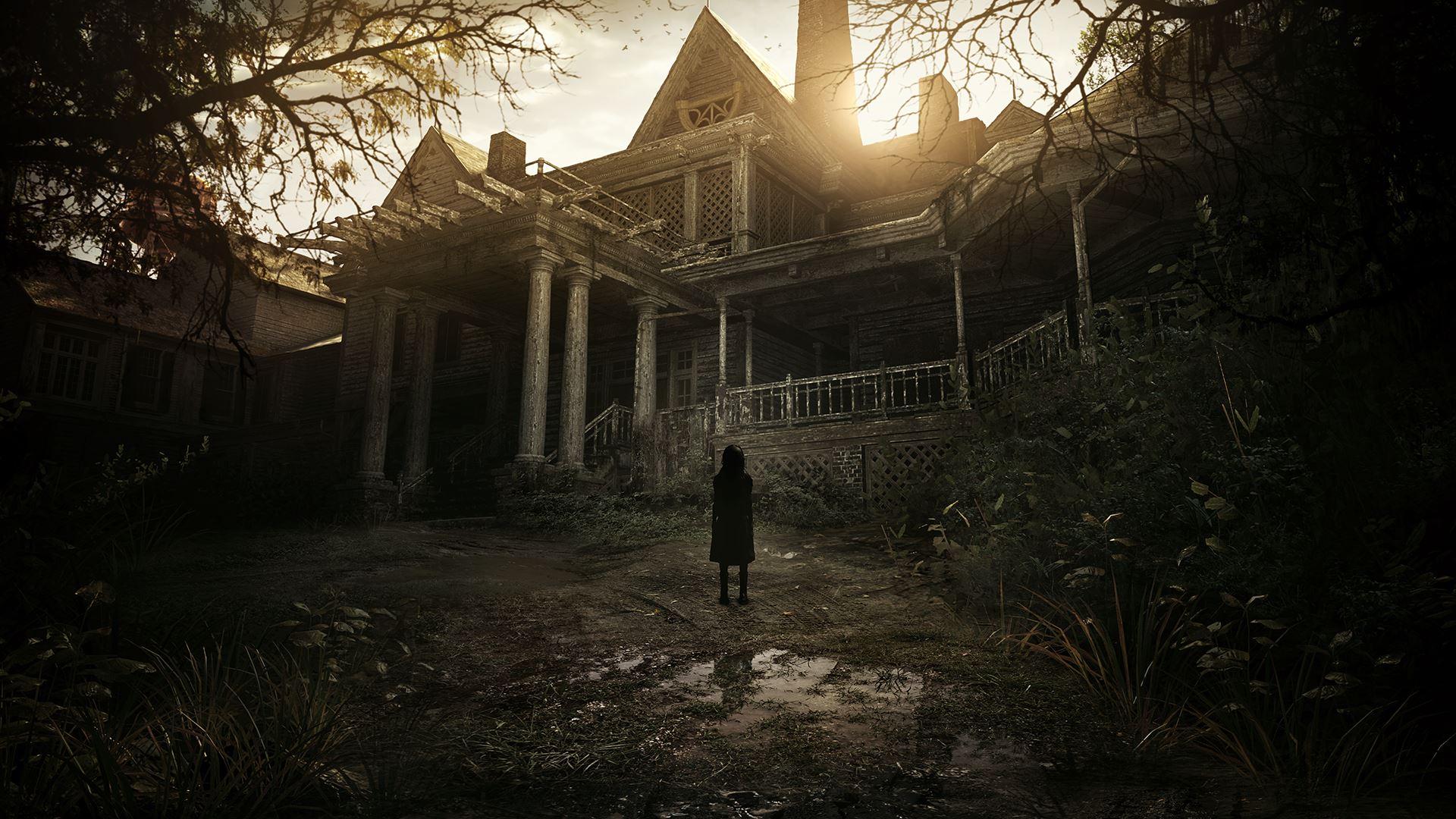
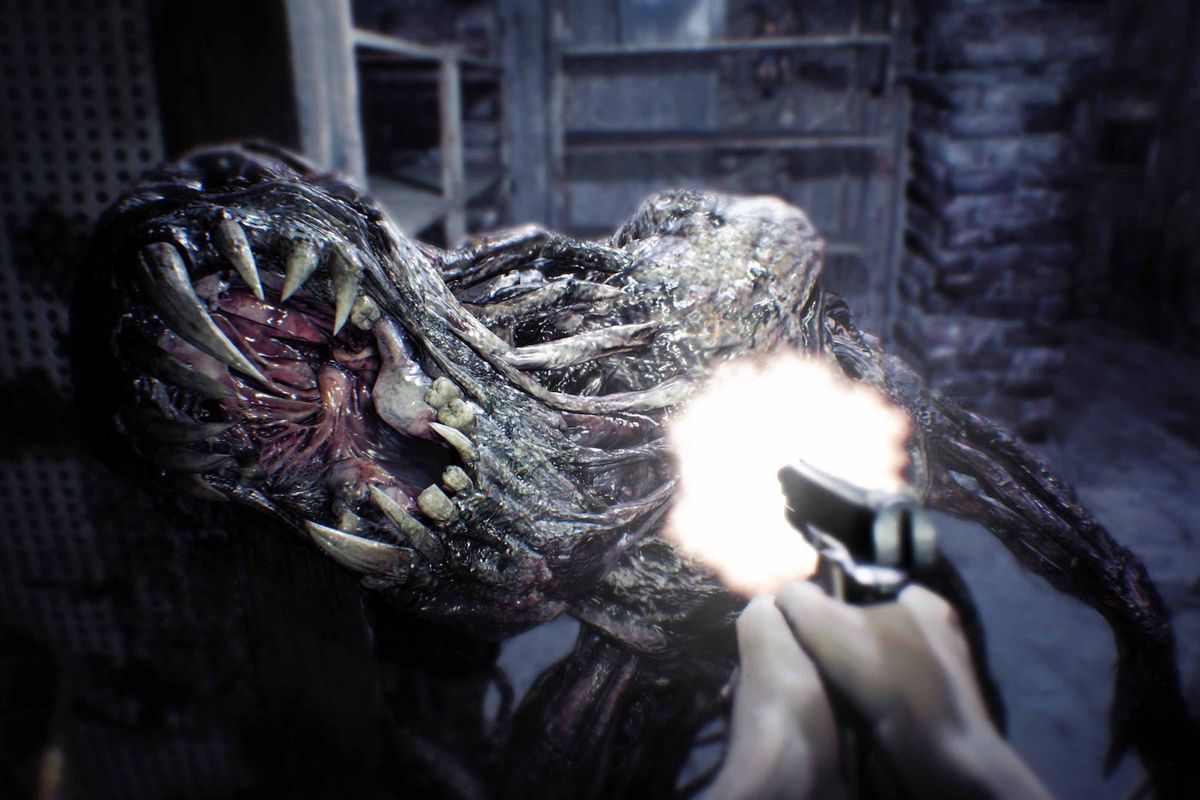
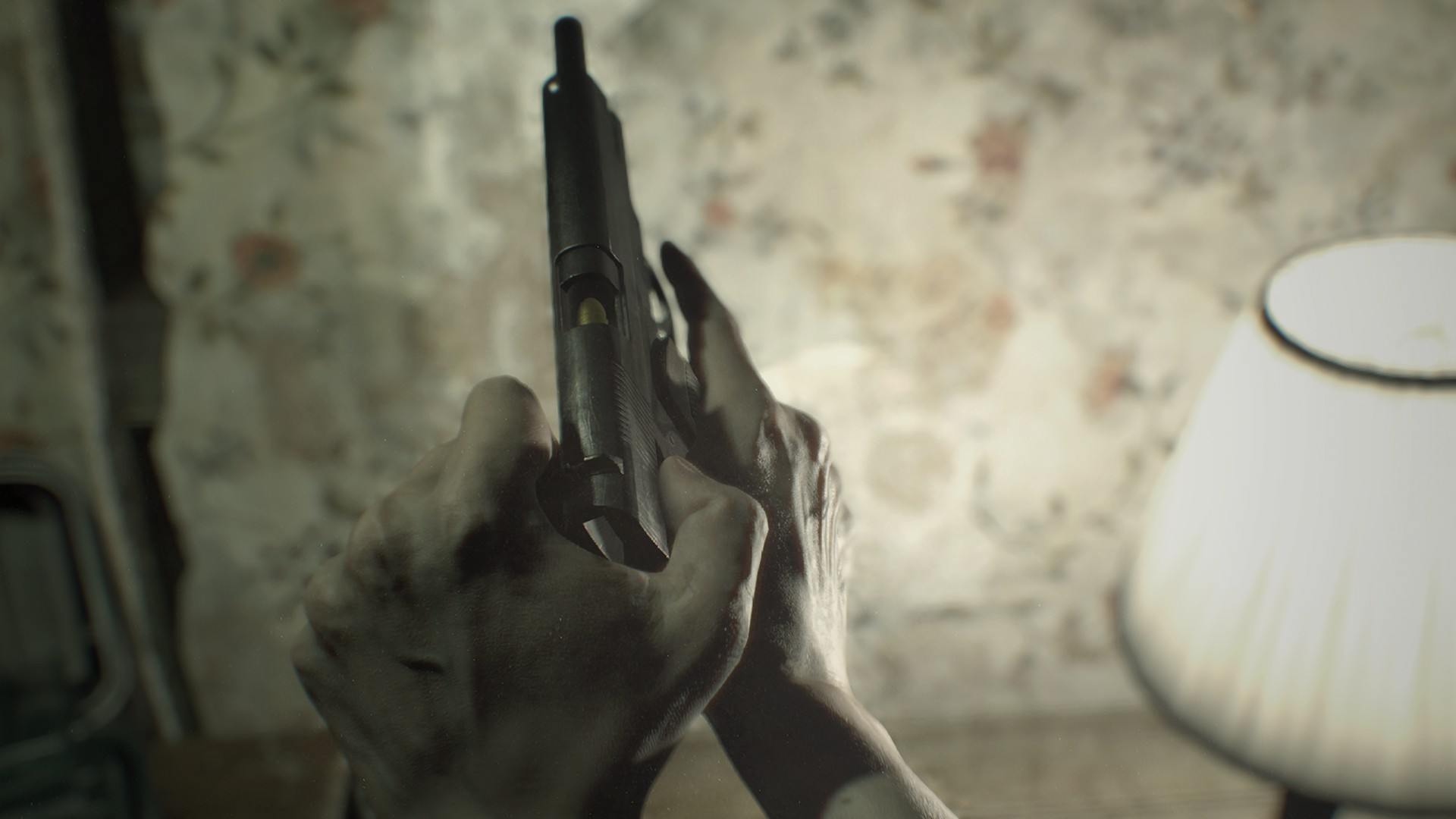
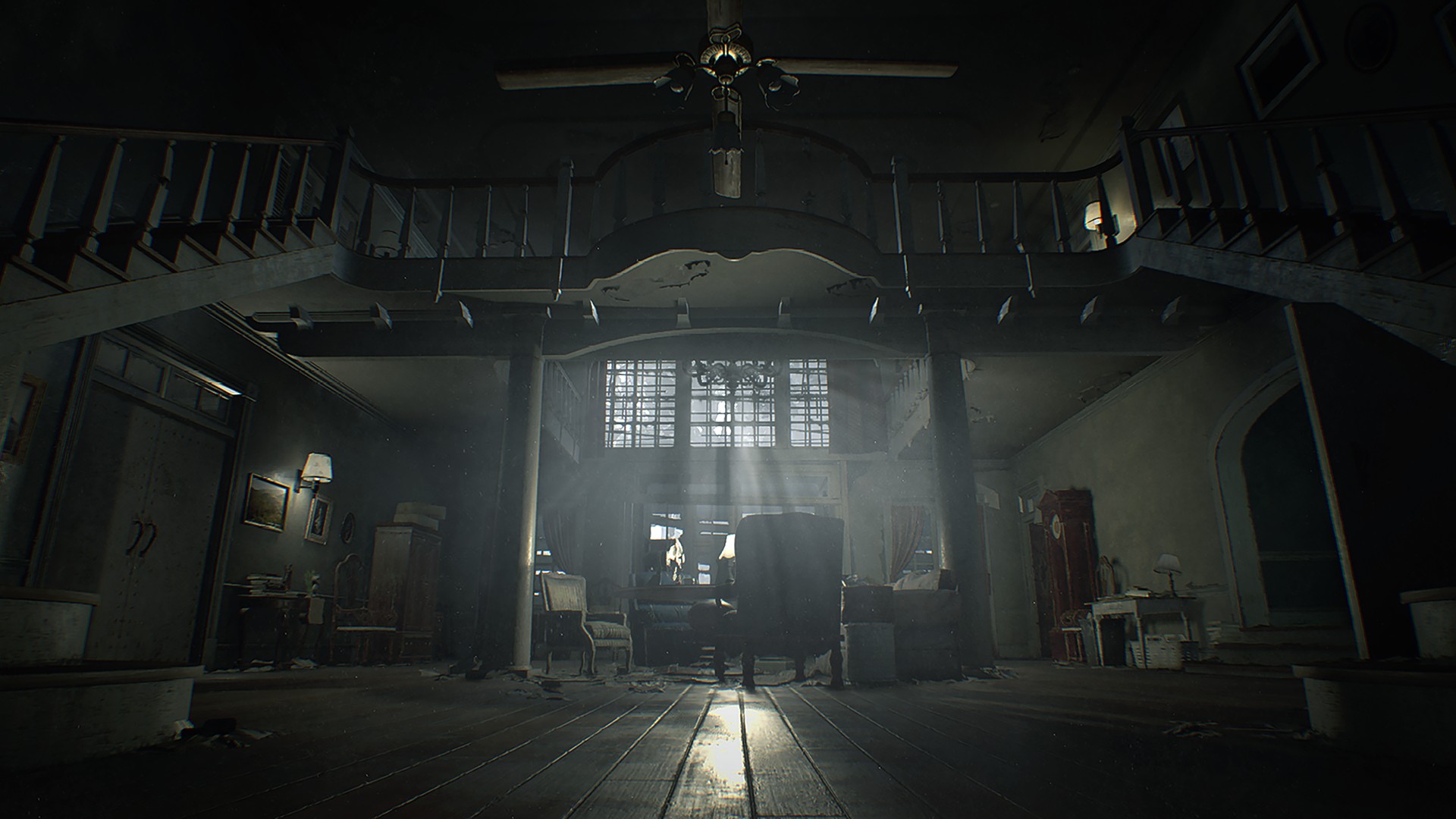
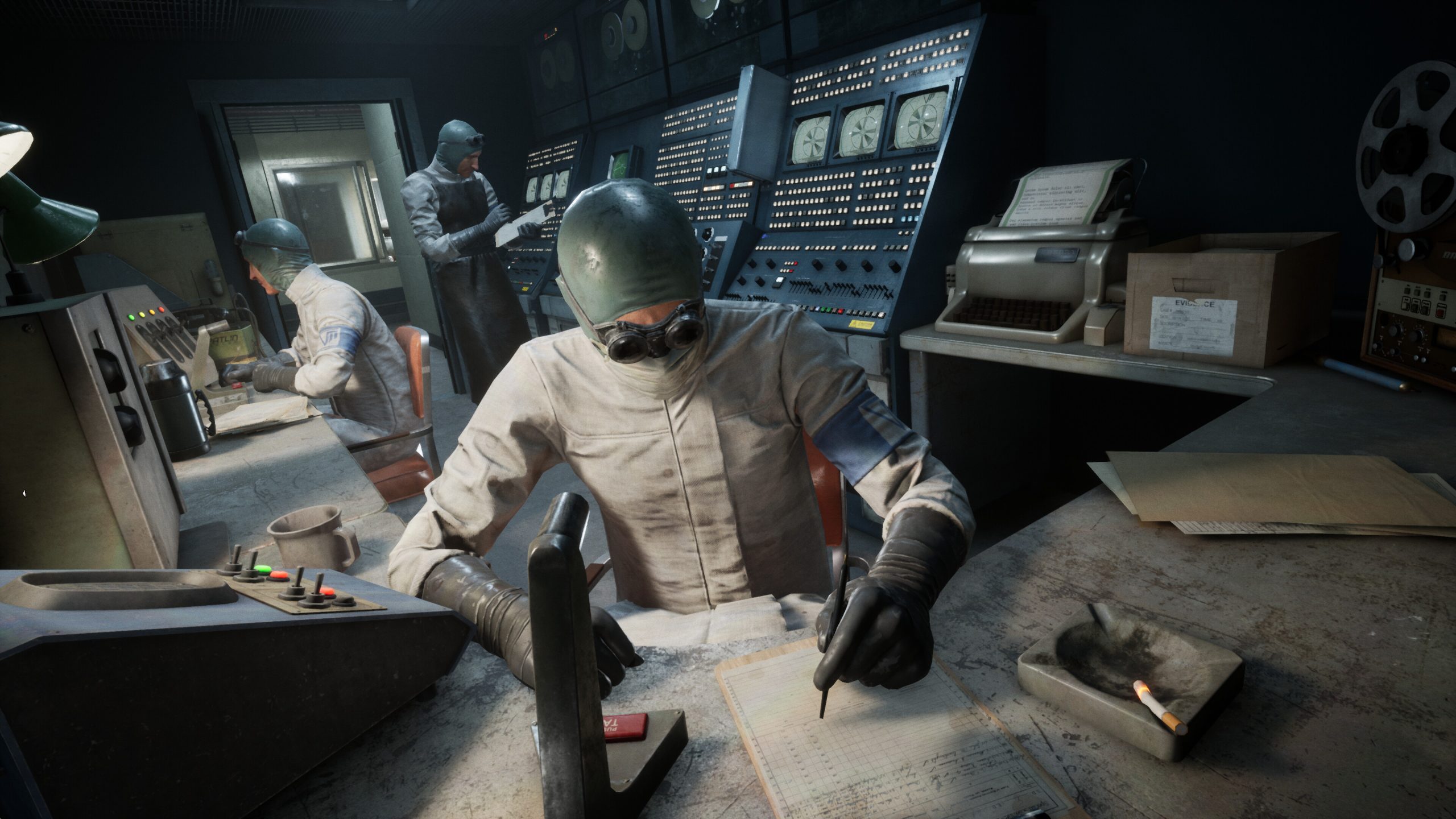
One of my main inspirations for my project is the Resident Evil series as it originally started with quite a similar premise to my own as an abandoned town, Raccoon City, is overtaken by a virus that turns people and animals into mindless biological weapons due to unethical experimentation by a corporation known as Umbrella. The primary point of inspiration I am drawing from the series in terms of my story is how the company has complete control over the town allowing them to have a secret lab underneath it as well as allowing experimentation on employees and citizens without repercussions. The small housing block that my game is set in is to be a cover for a secret lab that is run by a corrupt organisation using artificial pathogens to try and augment human ability.
Resident Evil 7 Key Art (Capcom, 2017)
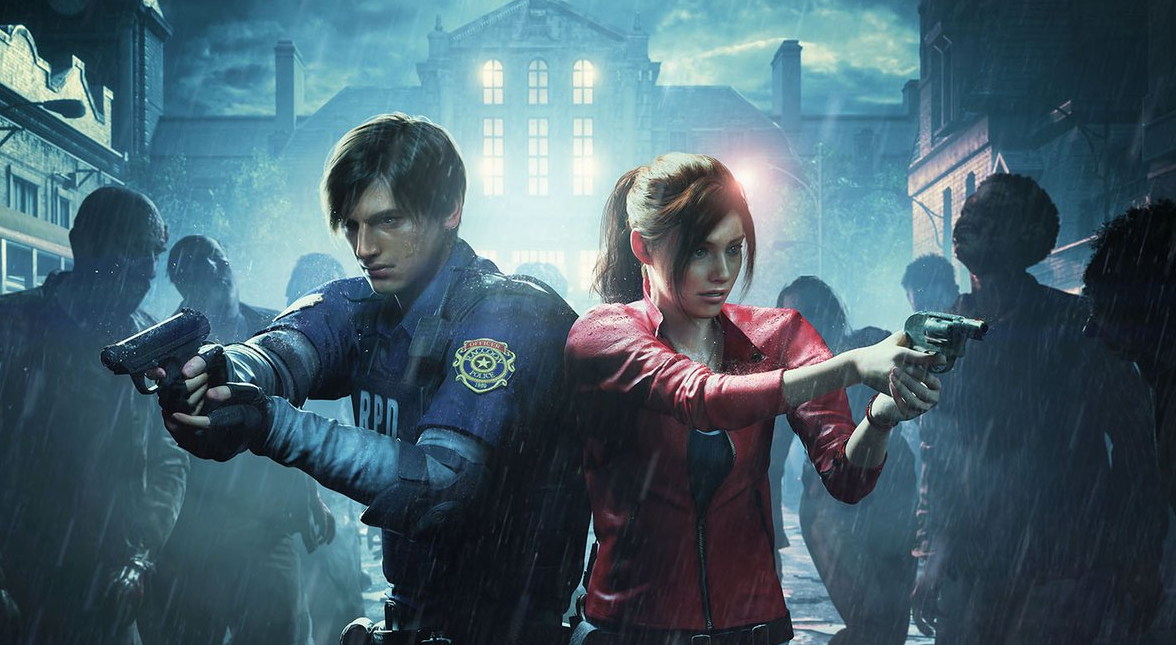
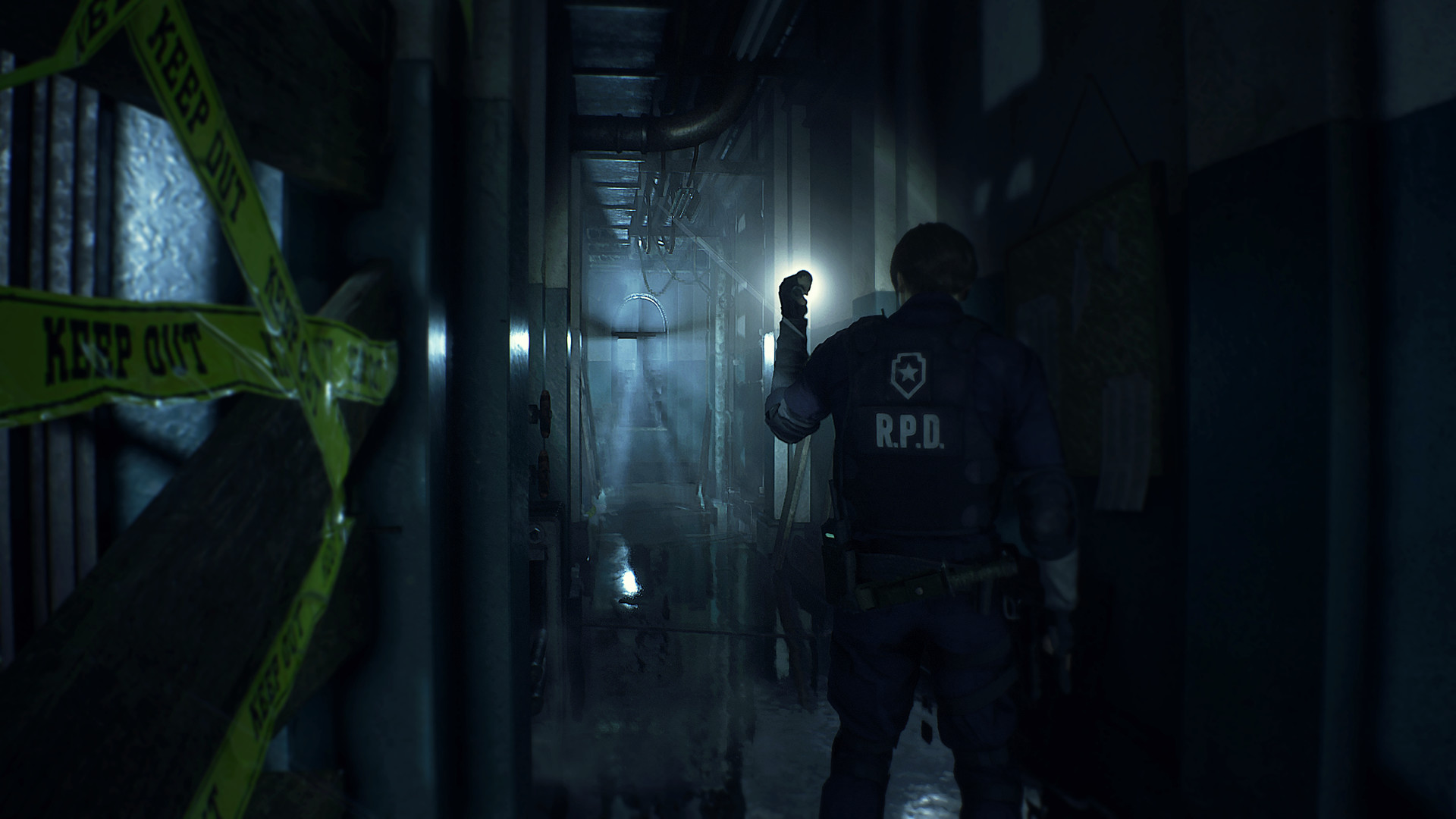
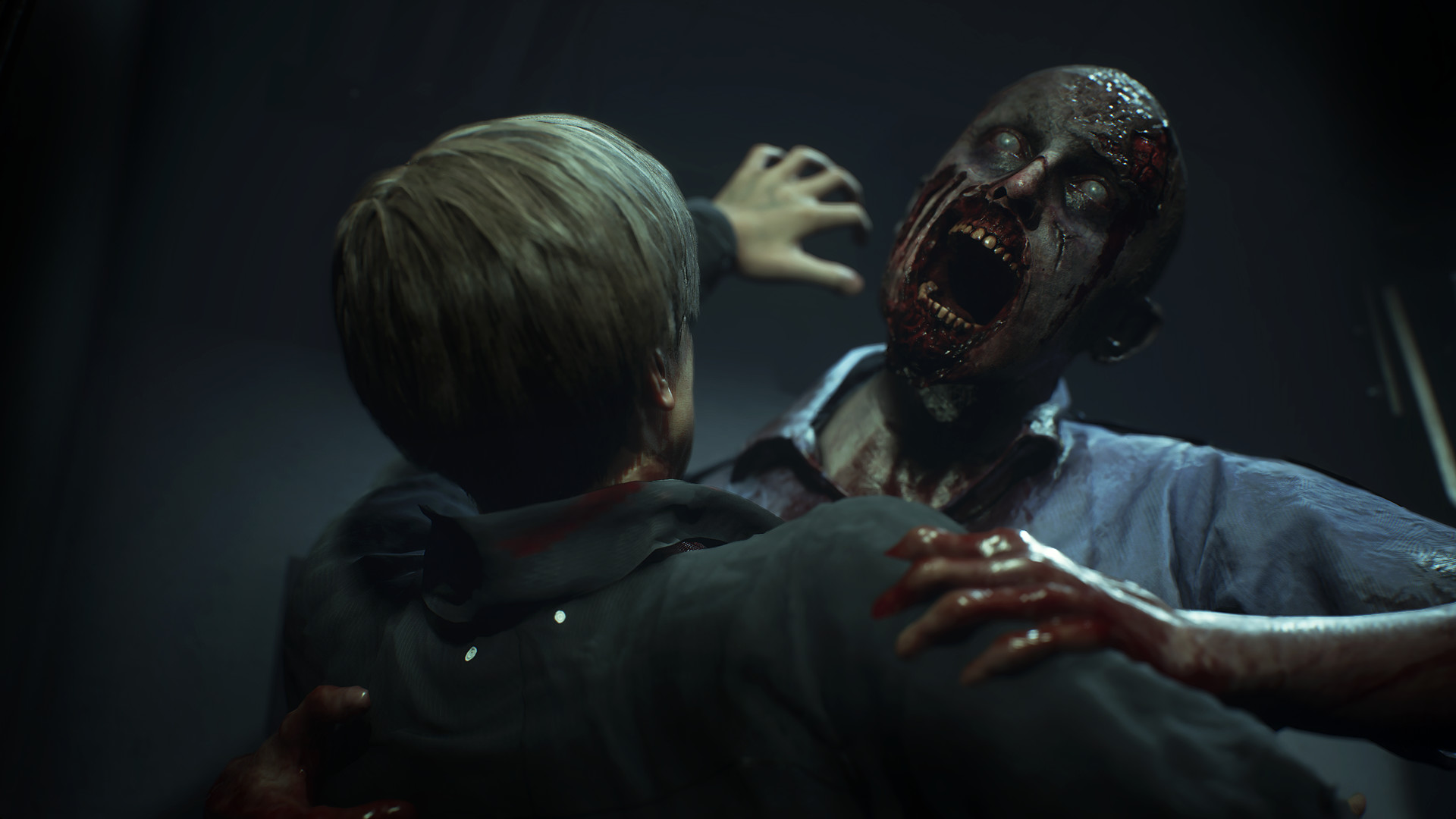
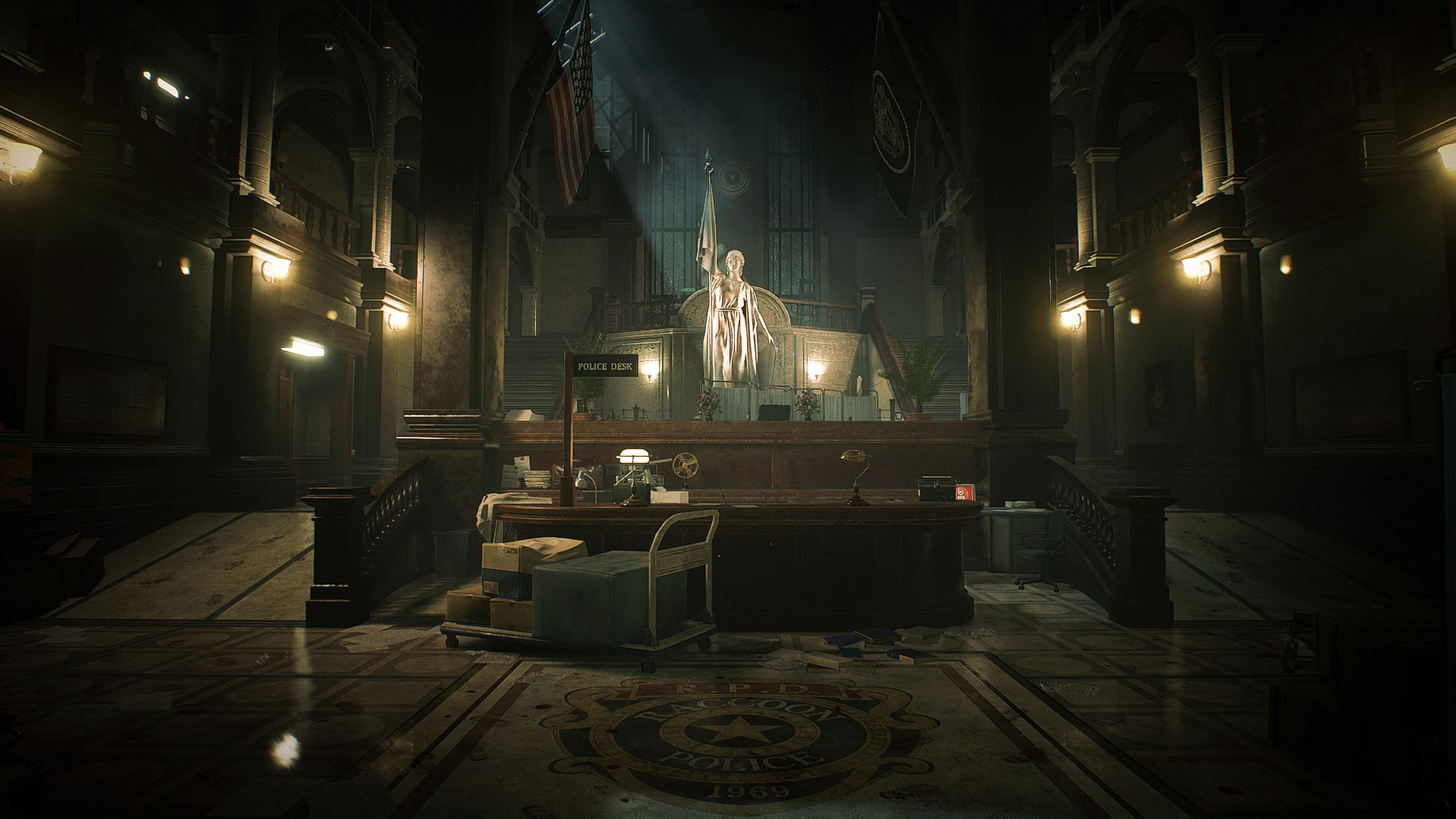
However, for the gameplay I am more inspired by the most recent non-remake titles in the series as they use a first person perspective instead of third person or fixed camera perspectives. The first person perspective will assist in creating the tense atmosphere I want for my game as well as it makes it feel a little more personal to the player.
Resident Evil 2 Cover Art (Capcom, 2018)
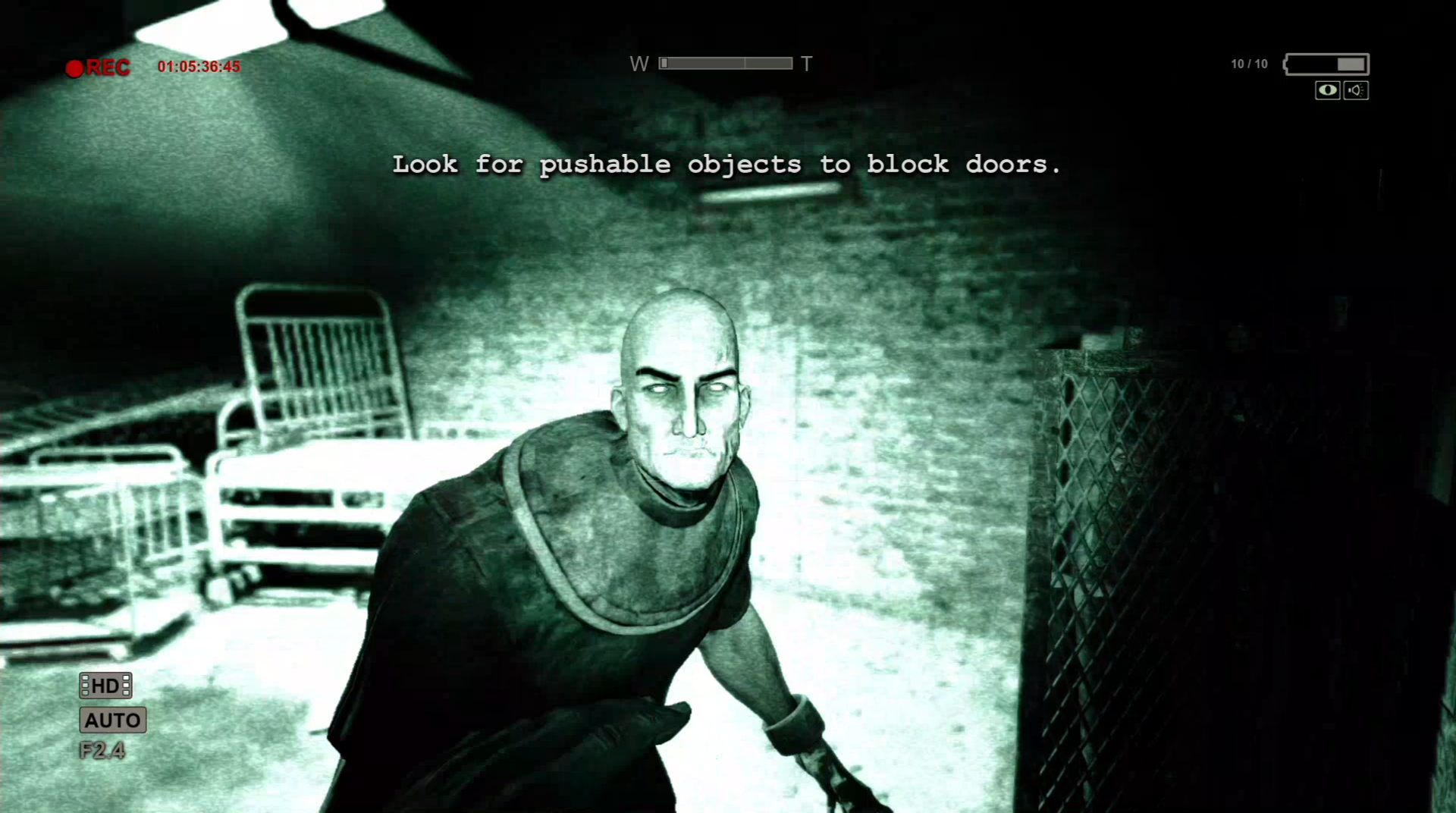
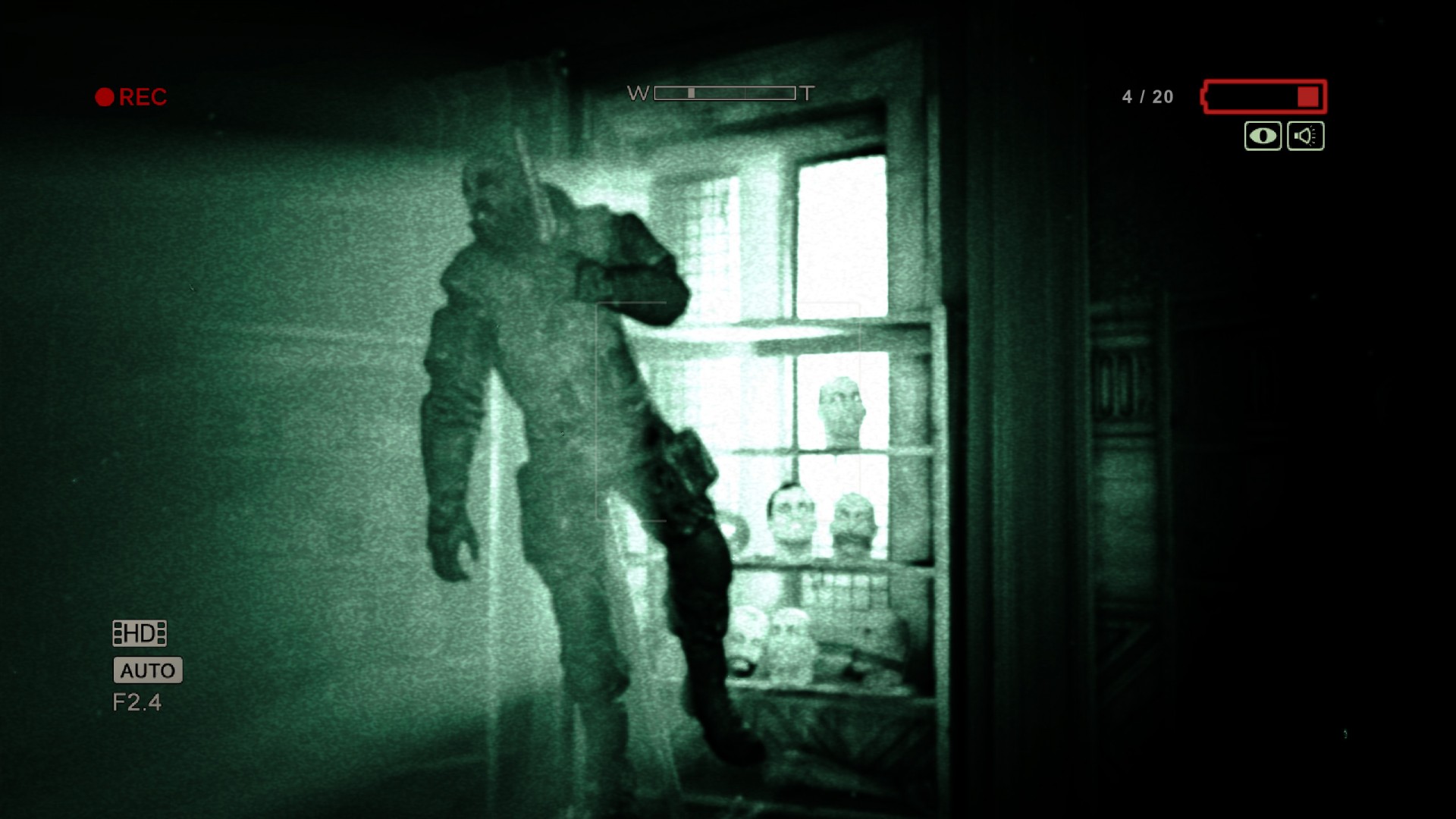
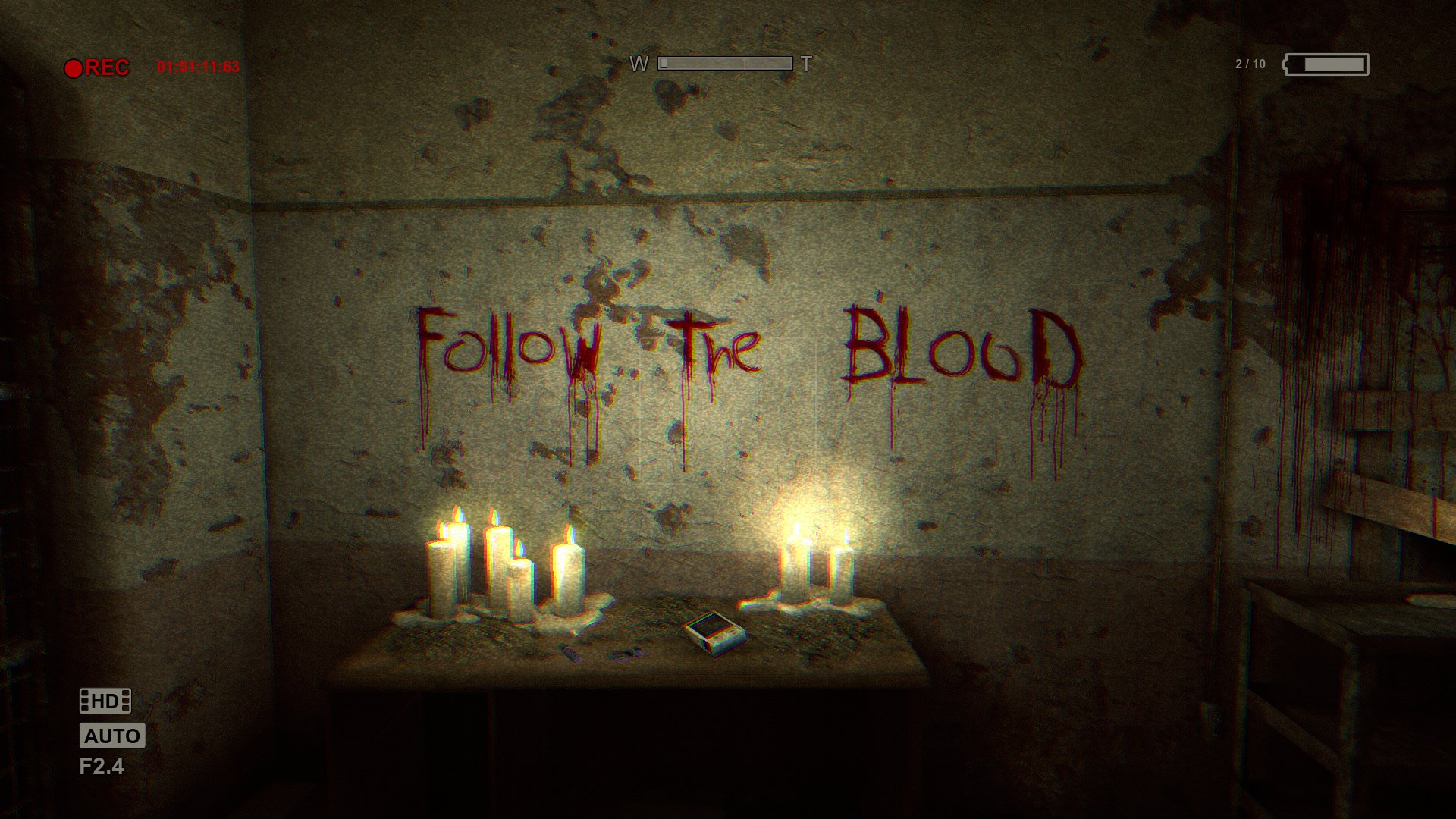
The game Outlast also serves as an inspiration for certain aspects of my project. The game takes place in an asylum that the player is exploring as they were tipped off about terrible things happening there due to experiments by the Murkoff Corporation. The aspects of the game that inspired my project are the gameplay and the way the story is presented to the player. In Outlast, the player has no way to combat any threats and must run or hide from any enemies. I wish to incorporate this type of gameplay in the early part of my game to show the struggle the player initially has before they adapt to the situation.
Outlast Gameplay Screenshot (Petit, 2014)
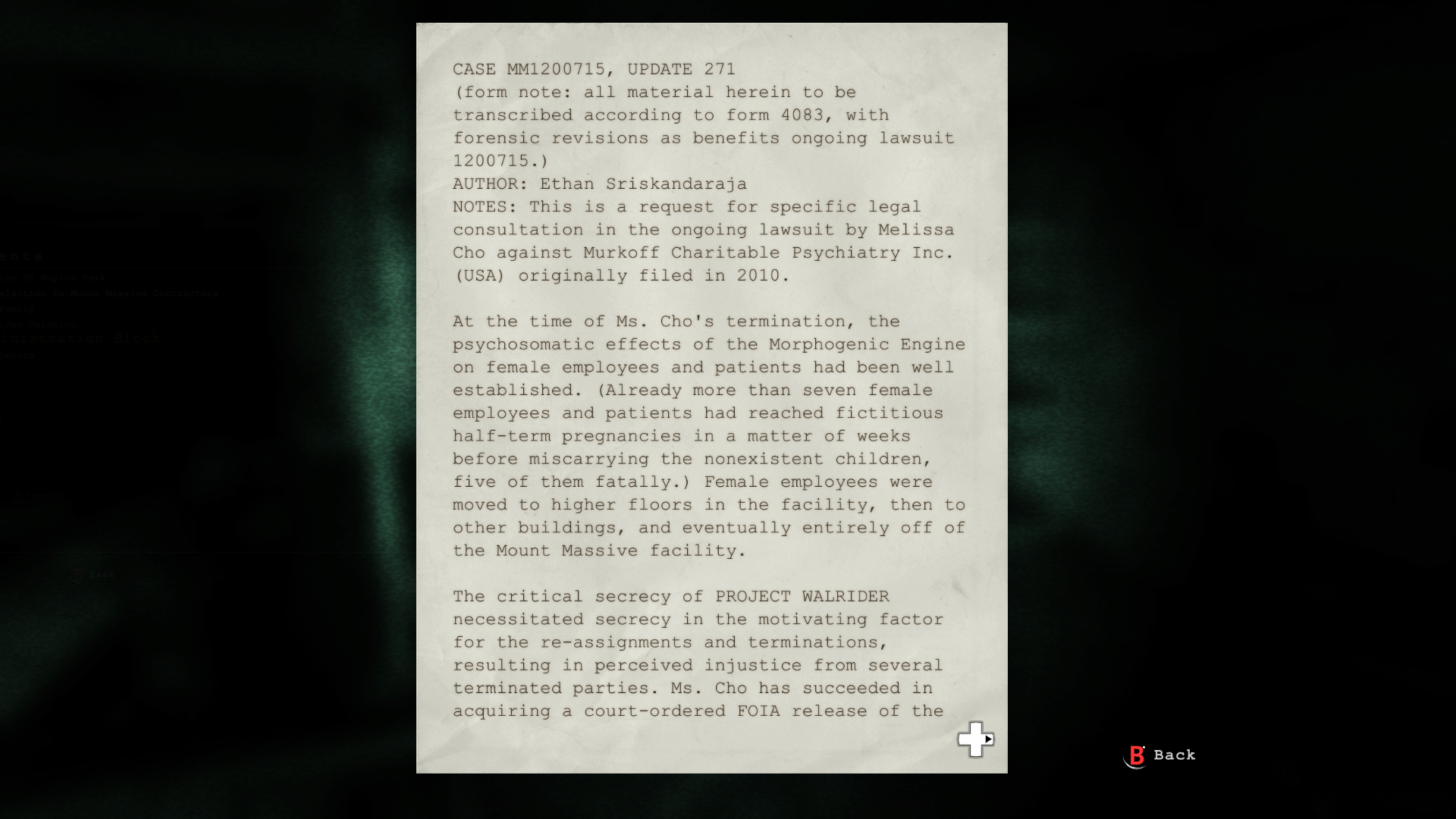
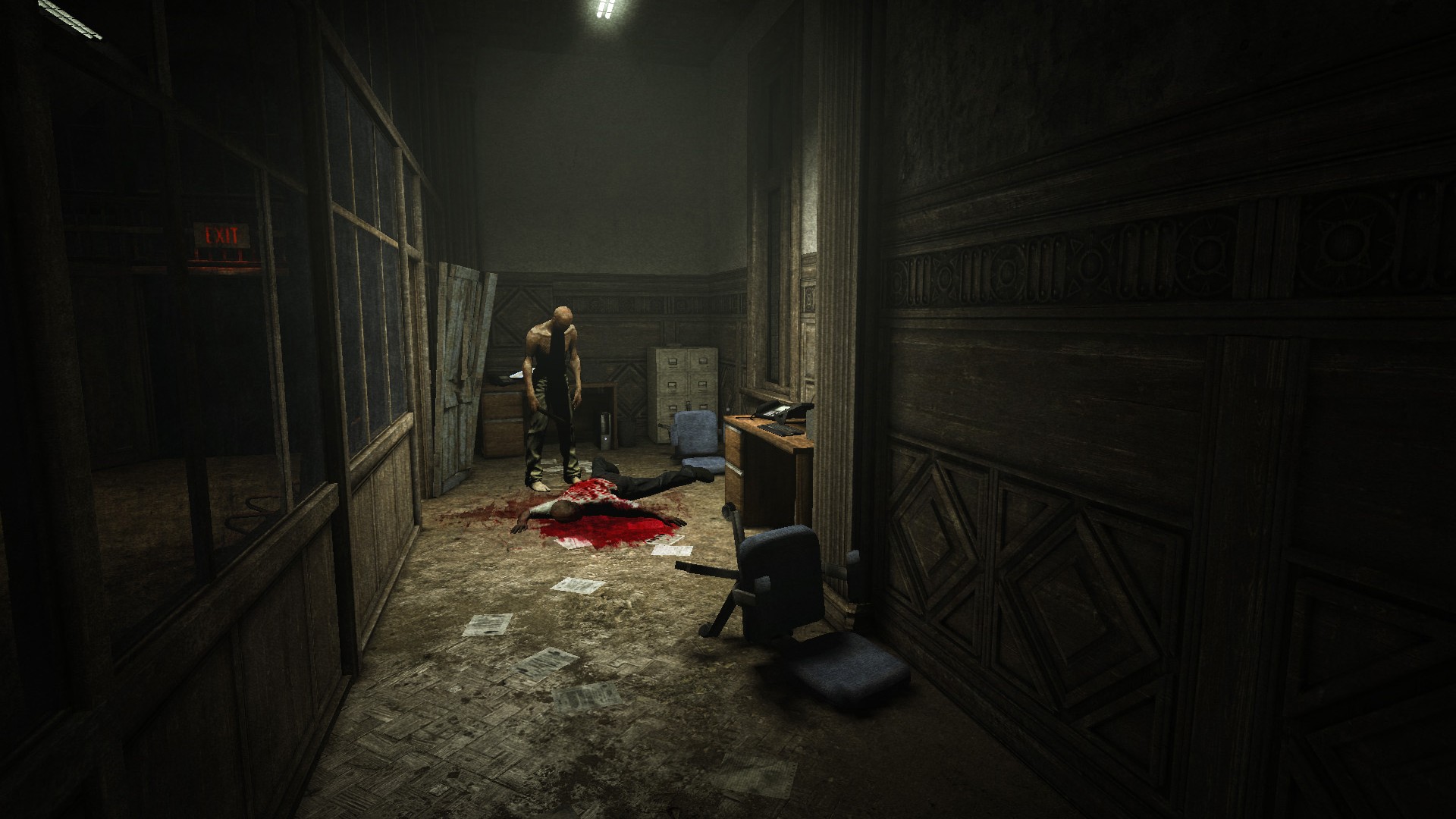
The primary inspiration I take from this game though is the way the story is told to the player. Besides from some important plot points, a lot of the story is told to the player through the environment or through notes that the player can optionally pick up and read allowing the player to piece together the story rather than having it all explained in an exposition dump. I aim to include a similar storytelling method in my game experience as most of the game will be exploring the environment and putting together what happened.
Outlast Impaled Man Screenshot (Red Barrels, 2013)
This page contains the final renders of my three animation sequences. I will discuss how these animations apply to my character design and the narrative that I created for my character.
Animation 1:
Animation 2:
Animation 3:
How the Animations Apply to my Character Design
These animations relate to my character because they show the injured state of my character after they escaped from the lab where they were experimented on which is one of the main aspects of my character design. The point of these animations are to show how resilient my character is and show some of the superhuman feats they can perform while being unable to use part of their body. These animations also connect to my character’s narrative as they are attempting to find a facility where they can repair their body so they can seek revenge on the entity responsible for their current state.